

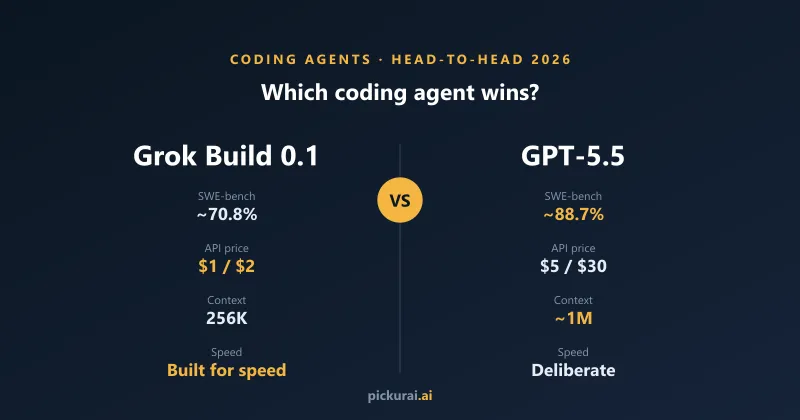
Two coding agents, two opposite bets. GPT-5.5, run through OpenAI's Codex CLI, sits at the very top of the coding leaderboard — it is a frontier model that undercuts almost nothing on capability. Grok Build 0.1, xAI's fast new agent, deliberately trades a few benchmark points for a token price a fraction of GPT-5.5's and a workflow built to feel familiar to Claude Code users. So which should you actually run? The honest one-line answer: GPT-5.5 for maximum capability on hard work; Grok Build 0.1 when token price or raw speed is what drives the decision — or when you already pay for X/Grok.
TL;DR — Key Takeaways
- Capability: GPT-5.5 wins. It tops SWE-bench Verified at ~88.7% versus Grok Build's vendor-reported ~70.8% — a ~18-point gap.
- Token price: Grok Build wins big — $1/$2 per million vs GPT-5.5's $5/$30, plus $0.20 cached input. That's ~15× cheaper on output.
- Context: GPT-5.5's ~1M-token window dwarfs Grok Build's 256K.
- Ecosystem: Grok Build is Claude-compatible (skills,
CLAUDE.md, MCP, hooks); GPT-5.5 uses Codex CLI's own conventions (AGENTS.md, MCP). - Pick by: hardest tasks and biggest codebases → GPT-5.5; high-volume, cost-sensitive, speed-first, or already-paying-for-X → Grok Build.
The head-to-head table
| Grok Build 0.1 | GPT-5.5 (Codex CLI) | |
|---|---|---|
| SWE-bench Verified | ~70.8% (vendor) | ~88.7% |
| API price (in / out) | $1 / $2 | $5 / $30 |
| Cached input | $0.20 / 1M | Discounted |
| Context window | 256K tokens | ~1M tokens |
| Speed | Built for speed | Frontier reasoning (deliberate) |
| Ecosystem | Claude-compatible (skills, MCP, hooks) | Codex CLI (AGENTS.md, MCP) |
| Bundled with | SuperGrok / X Premium Plus | ChatGPT Plus / Pro (+ API) |
Grok Build's SWE-bench figure is xAI's own internal harness; treat it as a vendor number until independent results land. GPT-5.5's ~88.7% is its public SWE-bench Verified leaderboard result. For exact, current token pricing on either, use the Token Cost Calculator.
Capability: GPT-5.5 is the frontier
On raw, hard-task capability, this is not a close contest yet. GPT-5.5 sits at the top of the SWE-bench Verified leaderboard at roughly 88.7% — essentially tied with Claude's Opus 4.8 for the crown — while Grok Build 0.1 reports around 70.8% on the same benchmark from xAI's internal harness. That is an 18-point gap on the industry's standard agentic-coding test. Add GPT-5.5's ~1M-token context window (versus 256K on Grok Build) and it can hold far more of a large codebase in working memory at once. If your work is genuinely complex — multi-file refactors, tricky debugging, big migrations — GPT-5.5, via Codex CLI, is the safer tool. It's the same frontier tier we place Claude Code in over in our Grok Build 0.1 vs Claude Code comparison.
Price: Grok Build is the value play
This is where Grok Build earns its place, and the gap is even wider than it is against Claude Code. At $1/$2 per million tokens — plus a striking $0.20 per million cached input — Grok Build is roughly five times cheaper than GPT-5.5 on input and about fifteen times cheaper on output ($2 vs $30). GPT-5.5's $30 output rate is actually the priciest of the frontier agents right now. For automated pipelines, code-review bots, batch refactors, or anyone running thousands of agent turns a day where "good enough" intelligence is fine, that difference compounds into a very different monthly bill. Just remember the all-in cost depends on your usage pattern and caching, not the sticker price — model it with the Token Cost Calculator before you switch.
GPT-5.5 is the better engineer. Grok Build 0.1 is the better deal. Which matters more depends entirely on the job — and the budget.
Speed and ecosystem: Grok Build's other edge
Grok Build was built for speed, and frontier reasoning models like GPT-5.5 are, by design, more deliberate — they think longer to hit those benchmark numbers. For interactive, tight-loop work where you want an answer now rather than the theoretically best answer in a minute, Grok Build's responsiveness is a genuine day-to-day advantage. On tooling, xAI made a shrewd move: Grok Build is deliberately compatible with the Claude Code ecosystem — your CLAUDE.md files, skills, MCP servers, plugins and hooks largely work out of the box. GPT-5.5's Codex CLI has its own, well-built conventions (an AGENTS.md project file and MCP support), but it is a different setup. If you're already living in a Claude-style config, Grok Build is the lower-friction switch of the two.
Which should you pick?
Choose GPT-5.5 (via Codex CLI) if you:
- Work on hard, multi-file engineering where topping the leaderboard actually matters.
- Need the ~1M-token context for large codebases.
- Already pay for ChatGPT Plus or Pro and want the frontier model in your terminal.
- Want the most reliable, careful agent for production repos.
Choose Grok Build 0.1 if you:
- Run high-volume, cost-sensitive agent workloads where the $1/$2 (and $0.20 cached) pricing compounds.
- Value speed and "good-enough" intelligence over leaderboard-topping capability.
- Already pay for SuperGrok or X Premium Plus — the agent is bundled in.
- Like that it's Claude-compatible, so trying it costs you almost nothing.
For the deeper dive on Grok Build's benchmarks, pricing and quirks, read our full Grok Build 0.1 review — it's the canonical page for everything about the agent itself.
What about Claude Code?
Claude Code, on Anthropic's Opus 4.8, sits in the same frontier tier as GPT-5.5 — the two trade the top of the SWE-bench Verified leaderboard between them (88.6% vs 88.7%). Against either frontier agent, Grok Build's argument is the same: it isn't claiming to be the smartest, it's claiming to be fast, cheap, and easy to slot into an existing setup. If you're weighing all three, our Grok Build 0.1 vs Claude Code breakdown covers the Anthropic side, and what Opus 4.8 actually costs puts the token economics next to each other.
The bottom line
Grok Build 0.1 vs GPT-5.5 isn't really a fight over the same crown — they're optimised for different things. GPT-5.5 is the capability leader and the right default for hard work and big codebases. Grok Build 0.1 is the value and speed play, especially if you're already in the X/Grok ecosystem or running agents at volume. The good news: because Grok Build speaks Claude's ecosystem, adopting it doesn't mean tearing up your workflow — you can keep a frontier agent for the hard jobs and reach for Grok Build on the cost-sensitive ones, with almost no lock-in either way.
Related: the full Grok Build 0.1 review, Grok Build 0.1 vs Claude Code, and Cursor vs GitHub Copilot. Still deciding? Run Pickurai's free finder.