

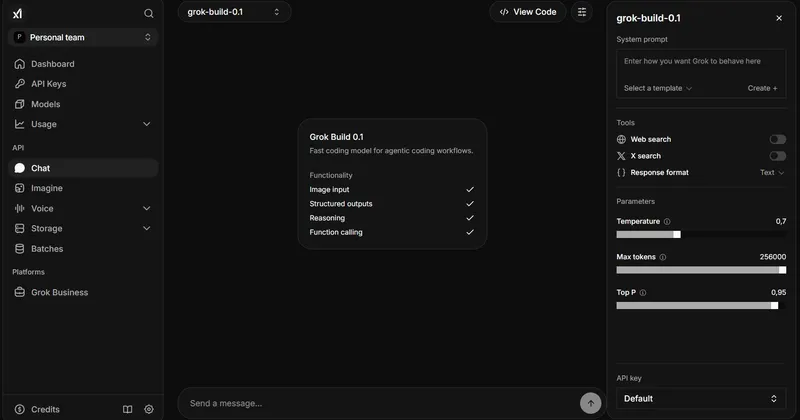
If you live in the terminal, the AI coding agent race just added a third serious contender. In May 2026, xAI shipped Grok Build, a command-line coding agent powered by a brand-new model called grok-build-0.1. It lands squarely in the territory already occupied by Claude Code and OpenAI's Codex CLI, and the pricing is aggressive enough to make it worth a closer look.
This page covers what the model is, what it costs, how it scores, and who should use it.
- What it is:
grok-build-0.1is xAI's fast agentic coding model, the engine behind the Rust-based Grok Build CLI launched May 14, 2026. - Pricing: $1.00 / $2.00 per million input/output tokens, and a headline $0.20 per million cached input tokens. The CLI is bundled free with SuperGrok and X Premium Plus.
- Specs: 256K-token context, text + image input, always-on reasoning, function calling, and structured outputs.
- Performance: a vendor-reported ~70.8% on SWE-Bench Verified: respectable for a "0.1" release, but roughly 15–18 points behind Claude Opus 4.7 and GPT-5.5.
- The pitch: good-enough intelligence at a low token price, with an ecosystem deliberately built to be drop-in compatible with Claude Code skills,
CLAUDE.mdfiles, MCP, plugins, and hooks.
What is Grok Build 0.1?
Grok Build 0.1 (API name: grok-build-0.1) is xAI's fast coding model, trained specifically for agentic software-engineering workflows rather than general chat. It's the engine behind the Grok Build CLI, a terminal-native coding agent written in Rust.
In plain terms: this is not a model you talk to for trivia. It's built to read your codebase, plan a change, edit files, run tools, and iterate, the multi-step loop that defines modern AI coding agents.
A few telling details from xAI's own documentation:
- The model carries the aliases
grok-code-fast-1andgrok-code-fast, which strongly suggests Grok Build 0.1 is the evolution (or rebrand) of the earliergrok-code-fast-1model rather than a clean-sheet design. If you arrived here looking for "Grok Code" as a separate product, it isn't one. We untangle the naming in Grok Code vs Grok Build. - Reasoning is always on: the model "thinks" before it answers by default, which suits multi-step debugging and refactors.
- It supports function calling and structured outputs, the table stakes for any tool that drives an agent loop.
The specs at a glance
| Feature | Grok Build 0.1 |
|---|---|
| Purpose | Agentic coding / tool use |
| Context window | 256,000 tokens |
| Inputs | Text + images |
| Output | Text (no fixed output cap) |
| Reasoning | Always on |
| Function calling | Yes |
| Structured outputs | Yes |
| Status | Public beta / early access |
What you actually get with the Grok Build CLI
The model is half the story; the CLI is what most developers will touch day to day. Launched May 14, 2026, Grok Build is available to SuperGrok and X Premium Plus subscribers and installs from the terminal with a single command. The features that stand out:
- Plan mode. For complex tasks, Grok Build drafts a plan first. You can approve it, comment on individual steps, or rewrite it entirely before any code is touched. Once approved, every change shows up as a clean diff, a sane guardrail for letting an agent loose on a real repo.
- Parallel sub-agents. It can run up to 8 sub-agents in parallel, which matters for large, multi-file work.
- Skills, plugins, hooks, and MCP. xAI made Grok Build compatible with the same ecosystem you may already use elsewhere: your
AGENTS.md, plugins, hooks, skills, and MCP servers work out of the box. It's even explicitly compatible with Claude Code skills andCLAUDE.mdfiles, a clear bid to lower switching costs. - Connectors. GitHub, Notion, Linear, Google Workspace, Microsoft 365, plus a growing list (Vercel, Canva, Gamma, S&P Global) and bring-your-own-MCP support.
Pricing: where Grok Build gets interesting
On the API, Grok Build 0.1 is genuinely cheap for an agentic model:
- $1.00 per million input tokens
- $2.00 per million output tokens
- $0.20 per million cached input tokens
That cached-input rate is the headline. For agentic coding, where you re-send a large, mostly-unchanged codebase context on every turn, prompt caching is exactly the lever that controls your bill. At $0.20/M cached input, the economics of long, iterative sessions look reasonable.
You can reach the model three ways: directly via the xAI API (public beta), through OpenRouter, and via Vercel AI Gateway (no markup, no separate provider account). The Grok Build CLI itself is bundled into SuperGrok and X Premium Plus subscriptions, so if you already pay for one of those, the agent comes at no extra cost.
A fairness note on "cheap": some analysts have pointed out that, for an individual developer using the CLI through a subscription, the all-in cost can work out far higher per unit of work than Claude Code or Codex CLI, partly because benchmark parity isn't there yet (see below). The API token prices are low; whether the total cost is low depends entirely on your usage pattern. Run your own numbers before you commit.
Performance: what the benchmarks actually say
Here's where Pickurai keeps it straight. The most-cited number for the model powering Grok Build (grok-code-fast-1) is 70.8% on SWE-Bench Verified: the standard agentic-coding benchmark. Two caveats that matter:
- It's xAI's own internal harness. That's not disqualifying, but it isn't an independent, apples-to-apples result either. Treat it as a vendor figure until third-party numbers land.
- It trails the frontier. That 70.8% sits roughly 15–18 points below Claude Opus 4.7 and GPT-5.5 on the same benchmark. Respectable for a v1 ("0.1") release, but if raw capability on hard, multi-file tasks is your only criterion, Grok Build is not yet the leader.
The takeaway: Grok Build competes on speed, price, and ecosystem fit, not on topping the leaderboard.
How it compares to the alternatives
| Grok Build 0.1 | Claude Code | Codex CLI | |
|---|---|---|---|
| Model focus | Fast agentic coding | Frontier agentic coding | Agentic coding |
| Benchmark standing | ~70.8% SWE-Bench (vendor) | Frontier (higher) | Frontier (higher) |
| Context | 256K | Large | Large |
| Ecosystem | Skills, MCP, plugins (Claude-compatible) | Skills, MCP, plugins | MCP |
| Bundled subscription | SuperGrok / X Premium Plus | Anthropic plans | OpenAI plans |
| API token price | $1 / $2 (in/out) | Higher | Higher |
The short version: Claude Code and Codex CLI are ahead on raw benchmark capability today. Grok Build's pitch is good-enough intelligence at a lower token price, with an ecosystem deliberately designed to be drop-in compatible with what you already use. If you want the deeper dive on Anthropic's agent, our complete guide to Claude Code in VS Code walks through the same plan-mode and MCP workflow from the other side of the fence. For a direct head-to-head, see Grok Build 0.1 vs Claude Code.
Who should pick Grok Build 0.1?
It's a strong match if you:
- Already pay for SuperGrok or X Premium Plus: the bundle math is hard to beat when the agent is already included.
- Run high-throughput, cost-sensitive agent workloads where the $1/$2 (and $0.20 cached) pricing compounds in your favor.
- Want a CLI that respects plan-before-execute discipline with clean diffs.
- Are building automated pipelines (code review bots, multi-step dev tooling) and value structured outputs + always-on reasoning.
Look elsewhere if you:
- Need maximum capability on hard, multi-file engineering tasks today, the frontier models still lead the benchmarks.
- Are an individual developer doing light, occasional work and don't want another subscription.
- Require independently verified performance numbers before adopting, the headline benchmark is still vendor-reported.
Which should you pick?
Choose Claude Code if you:
- Work on hard, multi-file engineering where capability beats price.
- Need the 1M-token context for large codebases.
- Already pay for a Claude plan: Opus 4.8 is included.
- Want the most reliable, careful agent for production repos.
Choose Grok Build 0.1 if you:
- Run high-volume, cost-sensitive agent workloads where the $1/$2 (and $0.20 cached) pricing compounds.
- Already pay for SuperGrok or X Premium Plus, the agent is bundled in.
- Want speed and "good-enough" intelligence over leaderboard-topping capability.
- Like that it's Claude-compatible, so trying it costs you almost nothing.
For the deeper dive on each, see our full Grok Build 0.1 review and what Opus 4.8 actually costs.
What about Codex CLI and GPT-5.5?
Both OpenAI's Codex CLI and GPT-5.5 sit in the same frontier tier as Claude Code on capability, well above Grok Build's current benchmark. If your only criterion is topping SWE-bench, the frontier agents (Claude Code, Codex CLI) lead. Grok Build's argument isn't "I'm the smartest". It's "I'm fast, cheap, and I fit your existing setup." Keep that framing and the choice gets simple.
The verdict
Grok Build 0.1 is a credible, cost-effective entry into the agentic-coding race, and the Claude Code-compatible ecosystem is a smart move that lowers the cost of trying it. It is not a frontier-beating model, and the marquee benchmark comes from xAI's own harness, so go in with realistic expectations.
For the right user, especially anyone already inside the X/Grok subscription ecosystem or running high-volume agent workloads, it's an easy "yes, test it this week." For everyone chasing the absolute top of the SWE-Bench leaderboard, it's a "watch this space": the 0.1 version number tells you xAI thinks the same.
Still weighing which coding agent fits your situation? Run Pickurai's free 6-question finder. It takes 30 seconds and no email, or read about how we score and compare tools.
Sources: xAI documentation and launch announcements, OpenRouter and Vercel AI Gateway listings, and independent coverage of the May 2026 Grok Build release. Benchmark figures are vendor-reported and should be treated as preliminary until independently verified.
Related, on Grok, my email, and a Cursor project: Grok, my email, and a Cursor project.