

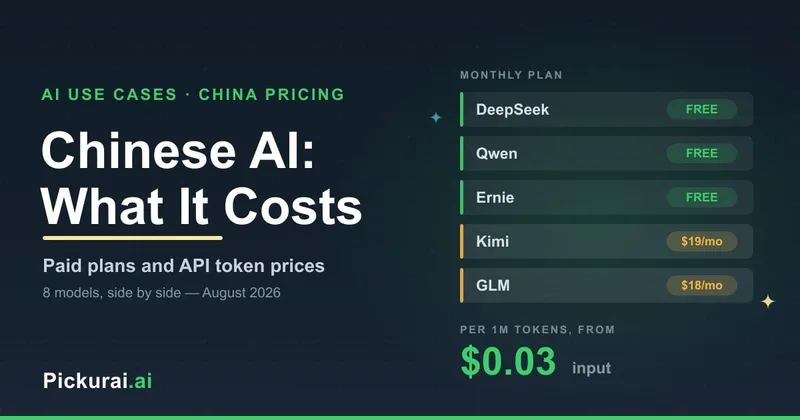
Half of the major Chinese AI models don't sell you anything at all. DeepSeek, Qwen, Ernie and Tencent's Hunyuan have no paid consumer subscription in August 2026 — their chat apps are free, full stop, and the only way to give them money is to buy API tokens. The four that do charge are Kimi ($19–$199 a month), Doubao (68–500 yuan a month, inside China), Zhipu's GLM (a $18-a-month developer coding plan) and MiniMax ($20–$120 a month). This article puts every one of those plans, and every per-token API price, in one place.
Key takeaways
- 4 of 8 have no paid plan. DeepSeek, Qwen, Ernie and Hunyuan monetise through the API, not through subscriptions.
- Kimi is the outlier. It charges Western consumer prices ($19 entry) and Western API prices ($3 / $15 per 1M tokens).
- The cheapest recurring plan is a developer plan: Zhipu's GLM Coding Plan at $18/month, not a chat subscription.
- Cheapest per token: Doubao Seed 2.0 Mini at $0.03 input / $0.29 output per 1M — over 150× cheaper than GPT-5.6 Sol on input.
- Doubao charging cost it users: 6.1 million monthly actives lost in May 2026 as paid tiers appeared.
- The floor is moving. DeepSeek's own docs warn of a significant API price increase coming.
Which Chinese AI Models Actually Have a Paid Plan?
This is the question most people are really asking, and the answer is counterintuitive if you're used to the Western market, where every chatbot has a $20 tier. Here is the complete picture for the eight Chinese models in our catalog:
| Model | Free tier | Paid plan? | Price |
|---|---|---|---|
| DeepSeek | Yes, unlimited | No | API only |
| Qwen (Alibaba) | Yes | No | API only |
| Ernie (Baidu) | Yes, free since Apr 2025 | No | API only |
| Hunyuan (Tencent) | Yes, via Yuanbao & WeChat | No consumer plan | API only |
| Kimi (Moonshot) | Yes (Adagio) | Yes — 4 consumer tiers | $19 / $39 / $99 / $199 per month |
| Doubao (ByteDance) | Yes, stays free | Yes — China only | ¥68 / ¥200 / ¥500 per month (≈$10 / $28 / $70) |
| GLM (Zhipu AI) | Yes (chat + free API models) | Yes — developer plan | From $18 per month (GLM Coding Plan) |
| MiniMax | Yes, daily credits | Yes — developer + video | $20 / $50 / $120 Token Plan; Hailuo video from ~$8 |
Verified 6 August 2026 against each provider's own pricing pages where published. Yuan-to-dollar figures are approximate conversions of Chinese list prices.
The Four That Won't Sell You a Subscription
DeepSeek is the purest case. There is no Plus tier, no Pro tier, and no paywall on file uploads or long conversations — the web app and the mobile app are free for individuals, and the only limit is fair-use throttling that surfaces as a "Server Busy" notice at peak hours. If you want to pay DeepSeek money, your only option is the API. That's not an oversight; it's the strategy that made DeepSeek the model everyone compared ChatGPT against.
Qwen is the same, with a wrinkle worth flagging because it trips people up: various pricing sites list a "Qwen Plus" subscription at $6–$15 a month. That is not a consumer plan — qwen-plus is the name of a mid-tier model on Alibaba Cloud's Model Studio API. Alibaba's consumer chat app is free and has no paid tier attached to it.
Ernie used to charge. Baidu sold a Wenxin Yiyan membership at ¥49.9–59.9 a month until it made the chatbot free for all users on 1 April 2025, and it has not reintroduced a consumer subscription since. Hunyuan never charged consumers at all: Tencent distributes it free through the Yuanbao assistant and WeChat, which is how it reaches over a billion people, and publishes no consumer plan in English.
In the West, the chatbot subscription is the business model. In China, the chatbot is distribution and the API is the business model. That single difference explains most of the pricing table above.
Doubao Broke the Seal — and Lost Six Million Users
ByteDance was the first of the giants to test whether Chinese consumers will pay. In May 2026 it surfaced paid Doubao tiers on its iOS listing: 68 yuan (about $10) a month for the standard plan, 200 yuan for enhanced, and 500 yuan for professional, with annual pricing at 688, 2,048 and 5,088 yuan. The free tier stays free, with search, Q&A, writing, image generation and voice chat unpaywalled; the paid tiers buy quota multiples and heavier work like presentations, data analysis and video.
The market answered immediately. Doubao shed 6.1 million monthly active users in May 2026, a 1.81% month-on-month decline, though it kept 330 million users and its position as China's most-used AI app. It's the single most useful data point in this whole article: the free-AI expectation in China is strong enough that even the market leader pays a price for charging. If you want the fuller picture of what Doubao is, we cover it in what is Doubao?
Kimi Is the Outlier: It Charges Like a Western Lab
Everything you assume about "cheap Chinese AI" breaks on Kimi. Moonshot AI runs a conventional four-tier consumer ladder on top of a free plan, and prices it exactly where OpenAI and Anthropic price theirs:
| Kimi tier | Monthly | Annual (per month) |
|---|---|---|
| Adagio (free) | $0 | $0 |
| Moderato | $19 | $15 |
| Allegretto | $39 | $31 |
| Allegro | $99 | $79 |
| Vivace | $199 | $159 |
A $19 entry tier is ChatGPT Plus territory. And Kimi's API is priced the same way — $3 input / $15 output per 1M tokens on K3, identical to Claude Sonnet 5's standard rate. Kimi is not competing on price; it's competing on the 1M-token context window and long-horizon agentic work, and charging accordingly. If you want it without paying, the free tier is genuinely usable.
The Cheapest Recurring Plan in Chinese AI Isn't a Chat Plan
It's Zhipu AI's GLM Coding Plan, from $18 a month. Instead of paying per token you get a credit quota that only works inside supported coding tools — Claude Code, Cline, OpenCode and similar. The tiers are Lite, Pro and Max, allocating roughly 2,000, 12,000 and 28,000 credits per rolling 5-hour window (10,000 / 60,000 / 140,000 per week). Independent pricing trackers put the Pro and Max list rates near $72 and $160 a month, with discounts of roughly 10% monthly, 20% quarterly and 30% yearly.
MiniMax runs the same playbook with its Token Plan: $20 (Plus), $50 (Max) and $120 (Ultra) a month, each a shared quota pool across its text, image, speech and music models, governed by 5-hour and weekly windows with no rollover. Separately, MiniMax's Hailuo video app sells credit subscriptions to creators, from a free daily allowance up to around $199.99 a month at the top.
Note the pattern: where Chinese labs have found something people will pay a monthly fee for, it is almost always developers, not chat users. That's the mirror image of the Western market, and it's why comparing "Chinese AI plans" to ChatGPT Plus mostly misses the point. If you're weighing the two billing models generally, we broke that down in API vs subscription: which is actually cheaper.
API Token Prices: Every Chinese Model
Here is where the real money changes hands. All figures are USD per 1 million tokens, list price, international billing:
| Provider | Model | Input | Output | Context |
|---|---|---|---|---|
| Doubao | Seed 2.0 Mini | $0.03 | $0.29 | 32K |
| GLM | GLM-4.7-FlashX | $0.07 | $0.40 | — |
| Hunyuan | TurboS | $0.11 | $0.28 | 256K |
| DeepSeek | V4 Flash | $0.14 | $0.28 | 1M |
| Hunyuan | T1 (reasoning) | $0.14 | $0.56 | 128K |
| Qwen | qwen3.6-flash | $0.25 | $1.50 | ≤256K tier |
| MiniMax | MiniMax-M3 | $0.30 | $1.20 | ≤512K tier |
| Qwen | qwen3.7-plus | $0.40 | $1.60 | ≤256K tier |
| DeepSeek | V4 Pro (flagship) | $0.435 | $0.87 | 1M |
| Doubao | Seed 2.0 Pro (flagship) | $0.47 | $2.37 | 256K |
| Ernie | ERNIE 5.1 (flagship) | $0.59 | $2.65 | 128K |
| GLM | GLM-5.2 (flagship) | $1.40 | $4.40 | — |
| Qwen | qwen3.7-max (flagship) | $2.50 | $7.50 | — |
| Kimi | Kimi K3 (flagship) | $3.00 | $15.00 | 1M |
Sorted by input price. DeepSeek, GLM, Qwen and MiniMax rates come from the providers' own published pricing pages; Doubao, Hunyuan and Ernie rates are USD equivalents of the Chinese cloud list prices as tracked on 3 August 2026. Alibaba has been running a 50% limited-time discount on qwen3.7-max, and Qwen prices are tiered by input length — the rate roughly quadruples above 256K tokens. Tencent's newest HY3 is in preview and has no settled English list price yet.
Two things jump out. First, the spread inside China is about 100× — Doubao Seed 2.0 Mini's input rate is 1/100th of Kimi K3's. "Chinese models are cheap" is far too blunt a statement to be useful. Second, the flagships cluster between $0.44 and $3.00 input, which is still below almost every Western flagship, but the gap is nothing like the headline 70× figure people quote from the cheap tier.
What One Real Month Actually Costs
List prices are abstract, so price a concrete workload: a production app making 25,000 requests a month at ~1,500 input and 800 output tokens each — 37.5M input plus 20M output tokens. This is the "Pro" preset in our Token Calculator, so you can reproduce and adjust any of it.
| Model | Monthly cost* | vs cheapest |
|---|---|---|
| Doubao Seed 2.0 Mini 🇨🇳 | ≈ $7 | — |
| Hunyuan TurboS 🇨🇳 | ≈ $10 | 1.4× |
| GLM-4.7-FlashX 🇨🇳 | ≈ $11 | 1.5× |
| DeepSeek V4 Flash 🇨🇳 | ≈ $11 | 1.5× |
| Hunyuan T1 🇨🇳 | ≈ $16 | 2.3× |
| DeepSeek V4 Pro 🇨🇳 | ≈ $34 | 5× |
| MiniMax-M3 🇨🇳 | ≈ $35 | 5× |
| qwen3.6-flash 🇨🇳 | ≈ $39 | 5.6× |
| qwen3.7-plus 🇨🇳 | ≈ $47 | 7× |
| Doubao Seed 2.0 Pro 🇨🇳 | ≈ $65 | 9× |
| ERNIE 5.1 🇨🇳 | ≈ $75 | 11× |
| GLM-5.2 🇨🇳 | ≈ $141 | 20× |
| qwen3.7-max 🇨🇳 | ≈ $244 | 35× |
| Kimi K3 🇨🇳 | ≈ $413 | 59× |
| Claude Opus 4.8 🇺🇸 (reference) | ≈ $688 | 98× |
| GPT-5.6 Sol 🇺🇸 (reference) | ≈ $788 | 113× |
*Estimated list-price cost for 37.5M input + 20M output tokens per month, before cache or batch discounts.
The practical read: a serious production workload on the best-value Chinese flagship, DeepSeek V4 Pro, costs about $34 a month — less than two Kimi subscriptions and about 5% of the same job on GPT-5.6 Sol. That's the number that has been reshaping developer defaults all year, and we unpack the geopolitics of it in the 2026 AI API price war.
The Discounts That Quietly Change the Math
Sticker price isn't the whole bill, and Chinese providers compete hard on cache pricing, which matters enormously for retrieval-heavy or repetitive workloads:
- DeepSeek charges $0.0028 per 1M cached input tokens on V4 Flash — a 98% discount versus the $0.14 cache-miss rate. On a high-repetition workload this is the single biggest lever available anywhere in the market.
- Zhipu's GLM prices cached input at $0.26 versus $1.40 on GLM-5.2 — roughly a fifth.
- Kimi charges $0.30 for cached input against $3.00 fresh, a flat 10×.
- Alibaba prices cache hits at 10% of the standard input rate, though explicit cache creation costs 125%.
- Free tiers on the API itself: Zhipu publishes genuinely free models — GLM-4.7-Flash and GLM-4.6V-Flash cost nothing per token. Alibaba gives new accounts 1M free tokens per model for 90 days, having ended its old open-ended free tier on 15 April 2026.
The Price Floor Is About to Move
One thing worth knowing before you build a budget on these numbers: DeepSeek's own API documentation warns that it plans to raise overall pricing "in the near future, with a significant increase expected." That is an unusually direct admission that 2026's rock-bottom rates were a customer-acquisition strategy, not a sustainable cost structure. Doubao's paid tiers point the same direction from the consumer end.
Treat every figure on this page as a snapshot dated 6 August 2026, not a permanent state of the world. If you're picking a provider for something long-lived, weight portability — an OpenAI-compatible API, which most of these offer — at least as heavily as today's rate.
So What Should You Actually Pay For?
- You just want to chat, for free: DeepSeek, Qwen, Ernie and Hunyuan cost nothing and will keep costing nothing. There is no upsell to resist.
- You want a paid consumer assistant: Kimi is the only real option internationally, from $19/month — and you're paying for the 1M-token context, not for a discount.
- You code all day: the GLM Coding Plan at $18/month is the best-value recurring subscription in Chinese AI, provided you work inside a supported tool. See how to install GLM.
- You're building an app: DeepSeek V4 Flash for volume, V4 Pro for frontier-class quality at ~$34/month on our test workload. Start with the DeepSeek API setup guide.
- You need absolute cheapest per token: Doubao Seed 2.0 Mini at $0.03 input — but access is Volcengine-centric and China-focused, so factor in integration friction.
The Cost That Isn't on the Price List
Every hosted price above sends your prompts to a Chinese cloud, under Chinese data jurisdiction, with content rules on politically sensitive topics. For everyday work that's usually an acceptable trade; for confidential or regulated data it isn't, and no discount fixes it. The escape hatch is that Qwen, Hunyuan and GLM ship open weights — self-host them and the per-token cost drops to zero and the jurisdiction question disappears with it. We go through the full risk picture in are Chinese AI models safe?
Pricing verified 6 August 2026 against DeepSeek's API pricing docs, Alibaba Cloud Model Studio's model pricing page, Z.ai's pricing and Coding Plan documentation, MiniMax's pay-as-you-go and Token Plan documentation, and Kimi's official pricing page. Doubao, Hunyuan and Ernie rates are USD equivalents of Chinese cloud list prices as tracked in early August 2026. Doubao subscription tiers and user figures as reported by Caixin, Pandaily and the South China Morning Post. Prices change often — check the provider before you commit.