

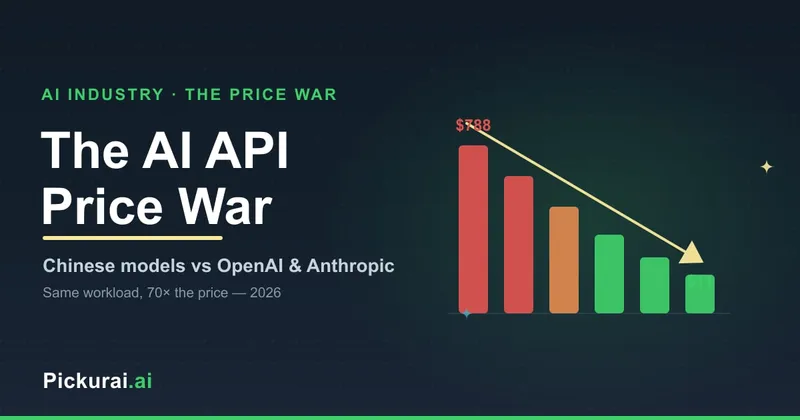
The same production workload that costs about $788 a month on OpenAI's GPT-5.5 costs roughly $11 on DeepSeek's cheapest model. That's not a typo, and it's not a rounding difference — it's the shape of the 2026 AI API price war. Chinese labs have driven inference prices down by an order of magnitude, Western labs have held the premium end and answered with cheaper sub-tiers, and the result is the widest price spread the market has ever seen. Here's the full map — and the one cost that never shows up on the pricing page.
Key takeaways
- The gap is ~10–70×, not a few percent. DeepSeek V4 Pro ($0.435/$0.87 per 1M) undercuts Claude Opus 4.8 ($5/$25) and GPT-5.5 ($5/$30) by roughly 10×; the Flash tiers stretch it to 70×.
- Cheap ≠ weak. DeepSeek V4 Pro scores ~80% on SWE-bench — frontier-class, at a tenth of the price.
- Why: open weights + efficiency + strategy. Most Chinese flagships ship open-weight, so hosting is commoditized; low price is a deliberate land-grab for developer mindshare.
- The West kept the top and cut the bottom. GPT-5.5, Opus 4.8, Fable 5 hold premium pricing; Gemini Flash-Lite and GPT-4.1 nano fight back at ~$0.10/$0.40.
- The catch is data, not quality. Cheap hosted Chinese APIs send prompts abroad and often train on them — the workaround is self-hosting the open weights.
The Flagships, Priced Head to Head
Start at the top, where the marketing happens. These are each provider's flagship general model, priced per 1 million tokens (input / output):
| Flagship model | Origin | Input | Output |
|---|---|---|---|
| DeepSeek V4 Pro | 🇨🇳 China | $0.435 | $0.87 |
| Qwen3-Max (Alibaba) | 🇨🇳 China | $1.20–3.00 | $6.00–15.00 |
| Kimi K3 (Moonshot) | 🇨🇳 China | $3.00 | $15.00 |
| Grok 4.5 (xAI) | 🇺🇸 US | $2.00 | $6.00 |
| Gemini 3.1 Pro (Google) | 🇺🇸 US | $2.00 | $12.00 |
| Claude Opus 4.8 (Anthropic) | 🇺🇸 US | $5.00 | $25.00 |
| GPT-5.5 (OpenAI) | 🇺🇸 US | $5.00 | $30.00 |
| Claude Fable 5 (Anthropic) | 🇺🇸 US | $10.00 | $50.00 |
Read that top row again. DeepSeek V4 Pro is a frontier-class, open-weight model priced at roughly one-tenth of Claude Opus 4.8 or GPT-5.5. It's not a toy tier — it scores around 80% on SWE-bench Verified, in the same league as the Western flagships on coding. The only Chinese flagship priced like a Western one is Kimi K3, which sits exactly on Claude Sonnet 5's $3/$15. Everything else from China lands below the American premium tier.
The Same Job, Eight Ways
List prices are abstract. What matters is what a real app costs. So let's price one concrete workload across the board: a typical production application making 25,000 requests a month at ~1,500 input and 800 output tokens each — about 57.5 million tokens. (This is the "Pro" preset in our Token Calculator, so you can reproduce and tweak any of these numbers yourself.)
| Model | Monthly cost* | vs DeepSeek Flash |
|---|---|---|
| DeepSeek V4 Flash 🇨🇳 | ≈ $11 | — |
| DeepSeek V4 Pro 🇨🇳 | ≈ $34 | 3× |
| Kimi K2.5 🇨🇳 | ≈ $83 | 8× |
| Grok 4.5 🇺🇸 | ≈ $195 | 18× |
| Gemini 3.1 Pro 🇺🇸 | ≈ $315 | 29× |
| Claude Sonnet 5 🇺🇸 / Kimi K3 🇨🇳 | ≈ $413 | 38× |
| Claude Opus 4.8 🇺🇸 | ≈ $688 | 63× |
| GPT-5.5 🇺🇸 | ≈ $788 | 72× |
*Estimated list-price cost for 37.5M input + 20M output tokens/month, before cache or batch discounts. Sonnet 5 shown at its standard $3/$15 rate; its introductory $2/$10 rate (through Aug 31, 2026) lands it near $275.
The spread from top to bottom is about 72×. And these are list prices — the real gap can be wider, because DeepSeek's cache-hit input rate drops to $0.0028 per 1M tokens for repeated context, and most providers offer 50% off on batch jobs. For a retrieval-heavy or high-repetition workload, the effective Chinese-vs-Western gap can exceed 100×.
Two years ago, "cheap AI" meant a smaller, dumber model. In 2026 it means a frontier-class Chinese open-weight model at a tenth of the American price. That is the single biggest change in the economics of building with AI.
The Race to the Bottom (of the Cheap Tier)
The flagship comparison tells one story; the budget tier tells another. Here Western labs have actually fought back hard, because a $0.10 model is a strategic weapon regardless of who makes it. The cheapest capable models on each side, per 1M tokens:
| Budget model | Origin | Input | Output |
|---|---|---|---|
| Qwen-Flash (Alibaba) | 🇨🇳 | $0.05–0.25 | $0.40–2.00 |
| Gemini 2.5 Flash-Lite | 🇺🇸 | $0.10 | $0.40 |
| GPT-4.1 nano | 🇺🇸 | $0.10 | $0.40 |
| DeepSeek V4 Flash | 🇨🇳 | $0.14 | $0.28 |
| Kimi K2.5 | 🇨🇳 | $0.60 | $3.00 |
| Claude Haiku 4.5 | 🇺🇸 | $1.00 | $5.00 |
Notice what happened: at the budget end, Google and OpenAI are competitive — Gemini 2.5 Flash-Lite and GPT-4.1 nano match anything on price. The West conceded the flagship-value crown to China but is fighting a real war for the cheap-and-fast tier, where volume lives. DeepSeek V4 Flash is the interesting one: it's priced like a budget model but is far more capable than a typical "nano" class, which is exactly why it's reshaping developer defaults.
Why Are the Chinese Models So Cheap?
It's not a mystery or a trick. Three structural forces stack up:
1. Open weights commoditize hosting. DeepSeek, Qwen, GLM and Kimi mostly ship as open-weight models. When anyone can host a model, no single vendor controls the price — inference becomes a competitive commodity, and the rate falls toward the cost of the GPUs. Western flagships (GPT, Claude, Gemini) are closed, so their makers set the price.
2. Efficiency is the headline, not an afterthought. DeepSeek in particular built its reputation on doing more with less compute. When your training and inference are genuinely cheaper to run, you can price lower and still make the unit economics work.
3. Low price is the strategy. For Chinese labs competing globally, aggressive API pricing is how you win developer mindshare against incumbents with a head start. Cheap tokens are a customer-acquisition tool. Western labs, meanwhile, are pricing for the frontier — the very top of capability, the deepest tooling ecosystems, and enterprise trust — and they can defend a premium there.
So What Are You Actually Paying Extra For?
If DeepSeek V4 Pro is a tenth the price and competitive on benchmarks, why does anyone pay $5/$25 for Claude Opus or $5/$30 for GPT-5.5? Three things the price gap buys:
The absolute top end. The very hardest reasoning, long-horizon agentic work and one-shot correctness still favor the Western flagships — Claude Opus 4.8, GPT-5.5, and Anthropic's Fable 5 tier. When a mistake is expensive, the premium model often pays for itself.
Ecosystem and tooling. Claude Code, Cowork, OpenAI's Agent tooling, deep IDE and cloud integrations — the Western platforms are further along as products, not just models. You're paying for the surrounding machine, not only the tokens.
Data governance. This is the big one, and it's the subject of its own guide: are Chinese AI models safe? Using a Chinese lab's hosted API sends your prompts to that company under its terms — DeepSeek stores data in China; Kimi's and Zhipu's international endpoints run from Singapore and may train on your input. For confidential or regulated data, Western labs' no-training-by-default posture is worth real money.
How to Actually Play This
High-volume, cost-sensitive, non-sensitive work → Chinese APIs. DeepSeek V4 Flash for cheap-and-capable, DeepSeek V4 Pro when you want near-frontier quality at a tenth of Western cost, Qwen-Flash for the absolute floor. This is where the 70× gap turns into a real P&L line.
Frontier reasoning and correctness-critical work → Western flagships. Claude Opus 4.8 and GPT-5.5 when the task is hard enough that capability beats cost. Reach for these deliberately, not by default.
Balanced daily driver → the mid-tier. Claude Sonnet 5 (especially at its $2/$10 introductory rate), Gemini 3.1 Pro, or Grok 4.5 sit in the sweet spot of capable-but-affordable.
Confidential or regulated data → self-host the open weights, or use Western hosting. Because DeepSeek, Qwen and GLM are open-weight, you can run them on your own infrastructure or through a US/EU cloud — keeping most of the cost advantage while removing the data-location risk entirely. That's the move that gets you the price war's upside without its catch.
Want to run these numbers against your own token volumes? Our Token Calculator prices every model above in seconds. And if you're weighing a specific matchup, we broke down Kimi vs Claude and ChatGPT vs Claude vs Gemini in detail.