

I code in Cursor most days, from Seville. I dropped my Claude plan in August because I wanted a model picker, so when OpenAI shipped GPT-6.1 Terra on 26 October 2026, I opened the help center before I opened a chat. I wanted to know whether the model was in the menu I already use.
Checked 27 October 2026
- Where it is. The help center says GPT-6.1 Terra is a model option in ChatGPT Work and Codex, and that it is not available in Chat. The API id is
gpt-6.1-terra. - Which plans. The 26 October release notes name Plus, Pro, Business, Enterprise, and Edu. The launch post names Plus, Pro, Enterprise, and Edu, and leaves Business off that sentence.
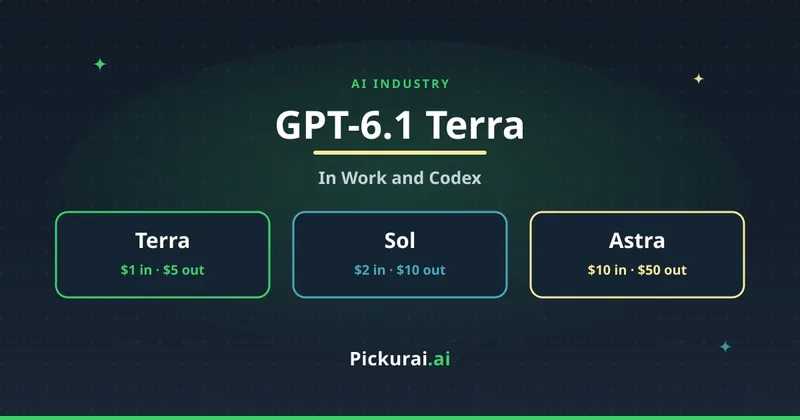
- What the API charges. Standard rates are $1 per million input tokens, $0.05 per million cached input tokens, and $5 per million output tokens. That is half of GPT-6.1 Sol on every line. Against GPT-6 Astra, input and output are a tenth, and cached input is a twentieth ($0.05 vs $1.00).
- What OpenAI claims. On their computer-use exam, at medium effort, Terra performs on par with Astra at a tenth of the price per token, and it finishes tasks more than three times faster than Astra and Sol. For the hardest coding and in-depth research, OpenAI recommends its bigger models.
- Spain and the EU. A country block for ChatGPT Work or Codex with Terra is not published. On the API, Terra supports US and EU data residency only, and it does not support UAE inference residency.
Where GPT-6.1 Terra shows up on your plan
ChatGPT is three products that share a login. Chat is the conversation, Work is the agent for a longer job that ends in a file (a document, a spreadsheet, a deck), and Codex is the coding agent in the desktop app, the CLI, the IDE extension, and Codex Cloud. The Work and Codex help page puts GPT-6.1 Terra, GPT-6.1 Sol, GPT-6 Sol, and GPT-6 Luna in Work and Codex, and says they are not available in regular ChatGPT conversations. GPT-6 and other models in ChatGPT repeats it under a Terra heading. If a normal chat shows no Terra, that matches the help center: you select it from the model list inside Work or Codex once the rollout reaches your account.
The plan list depends on which official page you have open. The launch post, and the Spanish translation of that post, say Terra is available to all Plus, Pro, Enterprise, and Edu users in ChatGPT Work and Codex. The release notes dated 26 October add Business, and neither page has a later note that resolves the difference.
On Enterprise and Edu, the release notes add a gate: an owner or admin has to give members permission to use the model and to use Work or Codex.
Free and Go are absent from both plan lists, even though the Codex plan page puts Codex itself on those plans, so a Free account should not expect Terra yet.
The 26 October notes say some Plus and Pro users may see GPT-6.1 Terra at Medium instead of GPT-6.1 Sol at Light in the default Power presets in Work, and that Standard and Fast modes are supported where available. Codex keeps a model you selected by hand, and the CLI does not use the slider. Signing in to Codex with your ChatGPT account spends the plan; signing in with an API key spends the token price below.
The release notes say your plan's overall usage limits stay as they were. The launch post says the same allowance covers more tasks with Terra than with GPT-5.6 Terra, and "substantially more" than with the two bigger models, without printing a task count.
The Work page says Plus and Business Standard include limited Astra usage, with credits afterwards, while Pro $100, Pro $200, and Business Premium can spend their full allowance on Astra. Ultrafast, the lower-latency mode, is on Pro $500 and eligible Enterprise and Edu workspaces, for Astra and GPT-6.1 Sol only.
GPT-6.1 Sol's default context in Work and Codex is 500,000 tokens, with no long-context surcharge on included usage; Terra has no published figure there. On the API, Terra's context window is 1,050,000 tokens and the maximum output is 128,000, and Sol and Astra publish the same two API figures.
Terra, Sol, and Astra on the rate card
A token is the chunk of text or image the API bills, and prices below are per million tokens. Short context on the pricing page means 272,000 input tokens or fewer. Above that line, the higher rate applies to the whole request, including the tokens under the line.
| Feature | GPT-6.1 Terra | GPT-6.1 Sol | GPT-6 Astra |
|---|---|---|---|
| API id | gpt-6.1-terra |
gpt-6.1-sol |
gpt-6-astra |
| What OpenAI says it is for | Visual reasoning, computer use, and clear writing. Matching photos to a catalog, reading a drawing, acting on a screen, drafting text. | Near-Astra performance for complex coding, computer use, and professional work, at a lower cost. | The most capable model, for the most demanding reasoning, coding, computer use, research, and document work. |
| Standard, per 1M tokens | $1 input, $0.05 cached input, $5 output | $2 input, $0.10 cached input, $10 output | $10 input, $1 cached input, $50 output |
| Input over 272K, whole request | $2 input, $0.10 cached, $7.50 output | $4 input, $0.20 cached, $15 output | $20 input, $2 cached, $75 output |
| Batch and Flex | Half of standard. Short context is $0.50 in and $2.50 out. | Half of standard. Short context is $1 in and $5 out. | Half of standard. Short context is $5 in and $25 out. |
| Fast | 2× standard. Short context is $2 in and $10 out. | 2× standard. Short context is $4 in and $20 out. | 2× standard. Short context is $20 in and $100 out. |
| Knowledge cutoff | 1 June 2026 | 30 April 2026 | 30 April 2026 |
| Reasoning effort | none, low, medium (default), high, xhigh, max | low, medium (default), high, xhigh, max. No none. | low, medium, high, xhigh, max. No none, and no default printed on the model page. |
| Inputs | Text and image in. Text out. Audio and video are unsupported. | Text and image in. Text out. Audio and video are unsupported. | Text and image in. Text out. |
Standard, long-context, Batch, Flex, and Fast rates are from the pricing page. Specs are from each model's page: Terra, Sol, Astra. Terra and Sol price cached input at 5% of the uncached input rate; Astra's $1 is 10% of its $10. A 30-minute cache write is 1.25× the input rate ($1.25, $2.50, and $12.50), and a 12-hour write is double that.
The launch post says the standard prices are 50% lower than GPT-5.6 Terra and GPT-6.1 Sol. Against Sol that is exact; against GPT-5.6 Terra ($2 in, $12 out) the output cut is deeper than half.
The models index tells new API users to start on Astra, pick Sol for balance, and pick GPT-6 Luna ($0.10 in, $0.50 out) for cheap volume. Its "where to start" sentence does not name Terra.
The GPT-6 guide adds two details. Tool calling on all three requires the Responses API. And when reasoning effort (how long the model may think) is anything other than none, you drop temperature, top_p, and top_logprobs; only Terra has none. The GPT-6 guide says to start at medium, and to raise it when the quality is worth the extra time and tokens.
What OpenAI measured
I have not run these tests. The numbers in this section come from the launch post and the forum announcement posted the same day.
On Agents' Last Exam, their benchmark of professional computer-use tasks, OpenAI says that at medium effort Terra scores 15 percentage points higher than GPT-5.6 Terra, at about one-third the cost, and performs on par with GPT-6 Astra at a tenth of the price per token. Terra's standard input and output rates are a tenth of Astra's; cached input is a twentieth ($0.05 vs $1.00). The parity, and the claim that Terra finishes tasks more than three times faster than Astra and Sol, are their measurements.
On Terminal-Bench 4.0, at maximum effort, OpenAI says Terra solves 50.3% of tasks, against 21.5% for GPT-5.6 Terra. The same paragraph says Sol and Astra remain the better choice for the most complex coding tasks, and the forum post adds in-depth research. Sol's and Astra's scores on that bench are not in the post.
On an internal benchmark of prompts that tempt the model into errors, OpenAI says the error rate at low effort fell from 53.6% on GPT-5.6 Terra to 16.7%, and to 4.3% at maximum effort, close to Astra and Sol.
They also say that at maximum effort Terra is over three times as token-efficient as Claude Opus 5.5, at a quarter of the price per token, which they estimate as about nine times lower cost per task. I did not reprice Anthropic's API to check it. The post also rates Terra Critical in cybersecurity under OpenAI's Preparedness Framework; details are in the linked system card.
What 200 invoices cost
The launch post uses one job to show why the price matters: reading incoming invoices and entering the details into accounting software. It does not say how many tokens that job uses, so here is my assumption before the dollars.
I priced 200 invoices, one request each, at 4,000 input tokens for the invoice and the instruction and 500 output tokens for the accounting line. I did not measure a real invoice; a dense photo can be larger and a one-line CSV row smaller. Nothing is cached, every request is under the 272,000 line, the speed is Standard, and there are no tool calls (web search is $10 per 1,000 calls, file search $2.50; no computer-use call price is listed for gpt-6.1-terra). The regional row adds the 10% uplift the pricing page charges on data-residency endpoints. That is 800,000 input tokens (0.8 million) and 100,000 output tokens (0.1 million).
| 200 invoices, these assumptions | Input | Output | Total |
|---|---|---|---|
| Terra, standard, one request each | 0.8 × $1 = $0.80 | 0.1 × $5 = $0.50 | $1.30 |
| Sol, same tokens | 0.8 × $2 = $1.60 | 0.1 × $10 = $1.00 | $2.60 |
| Astra, same tokens | 0.8 × $10 = $8.00 | 0.1 × $50 = $5.00 | $13.00 |
| Terra, Batch or Flex, one request each | 0.8 × $0.50 = $0.40 | 0.1 × $2.50 = $0.25 | $0.65 |
| Terra, Fast, one request each | 0.8 × $2 = $1.60 | 0.1 × $10 = $1.00 | $2.60 |
| Terra, standard, plus the 10% regional premium | $1.30 × 1.10 | $1.43 | |
| Terra, all 200 invoices in one prompt of 800,000 input tokens | 0.8 × $2 = $1.60 | 0.1 × $7.50 = $0.75 | $2.35 |
On the per-invoice run, Terra is $1.30 for the batch, or $0.0065 an invoice. Sol is double, $2.60, and Astra is ten times Terra, $13.00. That ratio holds for any mix of uncached input and output at standard short-context rates, and it breaks as soon as you change the mode.
Stuffing the 200 invoices into one prompt is the expensive version of the same tokens. At 800,000 input tokens the whole request pays long-context rates: $2.35 on Terra, $4.70 on Sol, $23.50 on Astra. Fast mode on Terra costs the same $2.60 as Sol at standard speed, while Batch or Flex, if the accounting system can wait, cuts the standard Terra bill to $0.65.
The whole run, 900,000 tokens in 200 requests, also fits under the Build-tier cap on Terra's model page: 1,000,000 tokens and 5,000 requests per minute.
Our token calculator has no Terra row yet; halve its standard Sol total for the same uncached tokens. For a subscription against an API key, see API versus the subscription, and for labs outside OpenAI, the API price war piece.
Languages, and what is published about Spain
The models index says the latest OpenAI models support multilingual capabilities. The Terra model page does not name a language, and it marks the speech, transcription, and translation endpoints as not supported. OpenAI published the announcement in Spanish, with the same plan list and the same $1, $0.05, and $5 rates as the English post.
A country restriction for Spain, or for the EU, on ChatGPT Work or Codex with Terra is not published. The 26 October release notes say you can use Terra in the Work and Codex experiences available with your plan, your region, and your workspace settings, without naming Spain, the EEA, or the EU. I live in Spain, and I cannot quote a sentence that says the picker is closed here or one that says it is open.
What is published is about where processing runs. The API data controls page says GPT-6.1 Sol and GPT-6.1 Terra support only US and EU data residency, where Europe means the EEA plus Switzerland. Fast mode keeps EU data residency for Terra, Sol, and Luna, but not for Astra, and the 10% regional premium is the price of that processing.
The ChatGPT residency article lists Europe (EEA plus Switzerland) among the regions where eligible Enterprise and Edu customers can store content and get inference residency. It predates this launch and does not name Terra; Codex Web is outside residency, while the Codex app and CLI are covered. The one limit the Terra notes name is the UAE: Terra does not support UAE inference residency, and the residency article says Work is not supported for workspaces on it.
Who should pick Terra
You have Plus, and you code in Codex. Terra is on the Plus rollout, inside Codex and Work, and a Plus seat includes only limited Astra usage. For everyday Codex work, a screen task, or a draft, I would select Terra, and check the picker: some Plus accounts already open Work on Terra at Medium, the preset the release notes describe. Keep Astra, and its thin Plus allowance, for the hardest jobs.
You pay the API. Invoices, forms, catalog photos, drawings, drafts, and other high-volume screen work are the job the launch post describes, at $1 and $5, or $0.65 for this 200-invoice example if Batch can wait. Keep each request under 272,000 input tokens unless you mean to pay the long-context rate on the entire call. For complex coding and in-depth research, OpenAI recommends Sol or Astra, at $2 and $10 or $10 and $50. If the work is bulk text and computer use is not the point, price Luna at $0.10 and $0.50 first.
You pay for Claude and want a picker. I was in that seat until August. I code in Cursor, and I left Claude because one model for every job was the part I did not want. The Opus comparison is OpenAI's estimate, not a reason on its own to cancel. Terra is a cheap model for the invoice pile and the screen task, and from Spain the API math above is enough to try it without buying a ChatGPT seat. Plans that let you choose the model is the longer version of why I wanted a picker, and Duet, dots, and Muse covers the country rules for the always-on agents.
Sources:
- OpenAI: Terra announcement (Spanish version) and forum announcement, 26 October 2026.
- API docs: pricing, models index, model pages for gpt-6.1-terra, gpt-6.1-sol and gpt-6-astra, the GPT-6 guide, and data controls.
- Help center: ChatGPT release notes, Enterprise and Edu release notes, GPT-6 and other models in ChatGPT, ChatGPT Work and Codex, Using Codex, and data residency for ChatGPT.