

I code in Cursor most days. I dropped my Claude plan in August because I wanted a model picker and a monthly bill between the $20 Pro rung and the $100 Max rung. I live in Spain today. On 21 October 2026 Anthropic published Claude Duet, a research preview of an agent that keeps working after you close the app. OpenAI's dots and Meta's Muse are the same kind of product. Both shipped earlier than Duet. I cannot turn any of the three on from here. What I wanted from the docs was the bill, because the sticker price leaves out the work that continues after the laptop is shut.
Checked 25 October 2026
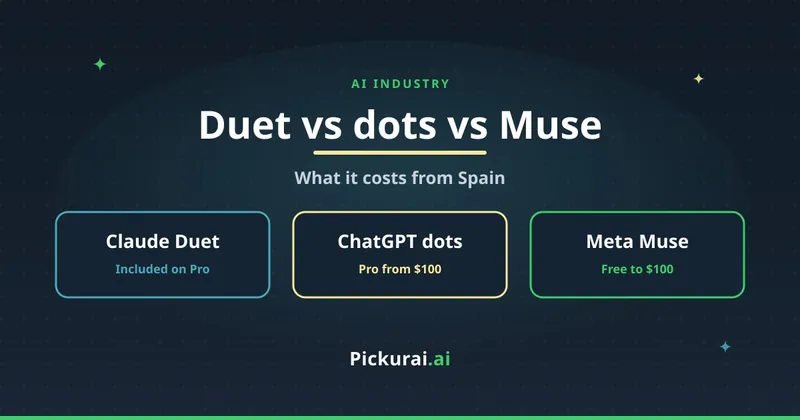
- Claude Duet is included on Pro and Max for US accounts only, behind a waitlist and locked to Opus 5.5. The morning brief and the check-ins spend the same five-hour and weekly limits as chat.
- ChatGPT dots come with Pro from $100 a month or a Business Premium seat. A conversation with the dot does not count toward ChatGPT limits. A task it starts in ChatGPT Work or Codex does. A 29 September note keeps dots usage off eligible allowances for the next month, through about 29 October 2026.
- Meta Muse has a free tier, Power at $20 a month for 500 million Muse tokens a week. The Maximum plan is $100 a month for 3 billion a week, in the US, Canada, and Japan.
- From Spain, none of the three personal plans appears on a country list the vendors have printed, and the Business Premium row for dots is the one those pages describe in two different ways.
Proactive AI agent comparison
I mean one specific thing by proactive: the agent messages you before you ask, it checks the apps you connected, it does some of the work while the laptop is shut. It is supposed to stop before it sends, pays, or deletes. All three products describe that behavior, though they do not charge the same way.
| Claude Duet | ChatGPT dots | Meta Muse | |
|---|---|---|---|
| Cheapest way in | Duet is included with Pro at $20 a month, or $17 a month if you pay $200 for the year, and Max starts at $100 a month, with no separate Duet fee. | A dot is included with Pro 100 at $100 a month, and Business Premium is $125 per user a month, or $100 per user a month billed annually, in a workspace of at least two seats. | Muse has a free tier with a usage limit, then Power at $20 a month and the Maximum plan at $100 a month. |
| Where you can open it | During the preview Duet is available in the United States only, and the account itself has to be a Claude account in the US. | Pro dots are for people 18 or older outside the EEA, Switzerland, and the UK, while Business Premium is described as supported ChatGPT regions on one page and as worldwide on another. Spain is named on neither. | Muse launched in the US on 8 September 2026, was named as available in Canada on 29 September 2026, and launched in Japan on 23 October 2026. |
| How you get in | Duet uses a waitlist, invitations go out in waves, and joining the list does not come with a date. | There is no public dots waitlist on the pages I read, the rollout is gradual, and access can take several days. | Muse shows no waitlist on the pages I read, you have to be in a country where it is available, and the product is still in limited testing. |
| Does background work spend the plan you already pay for? | The morning brief and the check-ins count, at the same rate as chats, against the five-hour session and the weekly limits. | A chat with the dot does not count toward ChatGPT limits. A task it starts in ChatGPT Work or Codex does. A 29 September note keeps dots usage off eligible plan allowances for the next month, through about 29 October 2026. | Paid Muse plans meter tokens by the week, with 500 million on Power and 3 billion on the Maximum plan. |
| What it will not do | Duet has no model picker and runs on Opus 5.5 only, you cannot watch its browser or take that browser over, and it will not trade securities, move money between accounts, or open someone else's account. Microsoft 365, Team, and Enterprise are still outside the preview. | The dot cannot start a phone call to you at launch, though you can call it, and texting is a US Pro beta rather than a Business or Enterprise feature. Changing a password stays with you, and the research it does while you are away stays read-only. | Muse cannot see your passwords or your payment methods, it asks before it sends email or pays, and the model it names is Muse Spark. |
Prices and country rules come from the vendors' own pages, read on 25 October 2026. Anthropic's prices exclude tax. A Max price on mobile may differ from the web price. A Muse token is Meta's unit on this subscription, separate from a dollar balance and from the API token our token calculator prices. The gaps are listed under What none of the three has published yet.
What Claude Duet actually is
Duet is its own app on iOS, Android, and claude.ai. Anthropic says it stays separate from the main Claude app for now. You message it by typing or by voice, in one ongoing thread, and you can open side channels that share the same memory. It runs on a computer in the cloud, so your phone can be off.
Each morning it looks across the email and calendar you connected, picks what it thinks needs you, and it can draft the first replies for you to review. Through the day it checks those accounts and messages you when something needs a decision. Bigger jobs come back as files: a research brief, a financial model, a slide deck, or a dashboard. Finished work shows up in a Make tab. A Tasks tab shows what is still in progress. Only you can mark a task complete.
It inherits memory, skills, and connectors from your Claude account. Anthropic names Gmail, Google Calendar, Google Drive, Slack, QuickBooks, HubSpot, Docusign, and Calendly, plus a marketplace it counts at over 6,000 connectors and plugins, and that count is Anthropic's. For a site with no connector, Duet uses its own browser in the cloud, and you type passwords into a form on your device, so they stay out of the chat.
With your approval, Duet can pay through Link, Stripe's wallet, or Shop Pay, using a one-time card for that purchase. Trading securities, moving money between accounts, and opening someone else's account stay off-limits even when you approve them. Duet does not make phone calls or send texts to other people, though with your approval it can send email from an account you connected. Microsoft 365 is still absent from Duet, even though Claude Pro on the web includes it. Slack works, with limits Anthropic has not numbered.
Duet runs on Claude Opus 5.5, with no model menu. It decides how much effort a job needs. You also cannot watch it work in the browser, take that browser over, or see every project and the files on your computer. It can read the work you already have in Claude, and it cannot change that work. Personal errands, such as booking tickets, are the weak side, because Anthropic built the core around work. The missing picker is why I left Claude for Cursor in August. Plans that let you choose the model are a different product from an agent that picks Opus 5.5 for you.
The Claude Duet waitlist
Access needs three things, from the help center: a Pro or Max plan, a Claude account in the US, and an invitation. Team and Enterprise are out of the preview for now, though Anthropic says it plans to bring Duet to those plans later.
The waitlist itself asks for your name, the email on your Claude account, your plan, and whether the phone is an iPhone or an Android. It can also ask what you do and what you would hand off first. Invitations go out in waves, and the help page is explicit that joining does not promise a day. The email on the waitlist has to match the Claude account and the Apple or Google account on the phone, so access stays tied to that address.
I did not join the waitlist. The form, as the help page describes it, never asks which country you are in, but the access rule still requires a US account. A Spanish Claude account fails that rule before the queue matters.
Claude Duet usage limits
This is the part the price card skips. During the preview, Duet is included with Pro and Max at no extra cost, while it spends the plan's usage limits, including the five-hour session and the weekly limits, at the same rate as chats in Claude. The morning brief and the check-ins count. You may hit those limits sooner than you would with chat alone.
Larger tasks, such as a financial model or a deck, take more model turns and more background work, which the product page counts toward the same limits. Duet checks connected accounts every few hours, because checking without a pause would use the plan up much faster, which the help page calls a set interval.
The limits are the pool you already share with the rest of Claude. On a paid plan, the web app, the desktop app, mobile, and Claude Code draw from one bucket: a session that resets on a rolling five hours, plus weekly limits. There is no fixed message count, because length, model, effort, and features all move the meter. Pro is at least five times the free plan per five-hour session. Max is five times or twenty times Pro per session, at $100 or $200 a month on the web. Max is billed monthly. Pro can be $20 a month, or $17 a month if you pay $200 for the year. Those figures are claude.com/pricing and the Max plan page as of today. Web prices exclude tax, though a Max price on mobile may differ.
A morning brief draws on the same pool as Claude Code, so a day near the five-hour cap gets shorter. When you hit the cap, the general limits page says you can wait for the reset or upgrade the plan, with the new limits applying right away. With usage credits enabled, the work continues on those credits instead of stopping.
When you are admitted, Anthropic refills both the five-hour session and the weekly limits once, and that refill stays available until 30 November 2026.
If the seat is scarce, the other bill is the API, which we compared with the subscription in API versus the $20 plan. Duet still charges the seat you already pay for.
Claude Duet vs ChatGPT dots
On 29 September 2026 OpenAI introduced dots, an always-on agent inside ChatGPT, powered by GPT-6 Astra, with its own cloud computer and browser. Your first dot is included on Pro and Business Premium at no extra cost. You create it in the mobile app, the desktop app, or a desktop browser, not on mobile web. After setup it also works in Slack and Microsoft Teams. You can open its computer and take over, which Duet does not allow. You can pause the dot.
OpenAI's launch post and the ChatGPT Learn page both say conversations with your dot do not count toward ChatGPT usage limits, though a task it starts in Codex or ChatGPT Work counts toward those products' limits as usual. Learn also says the research the dot does on connected information is read-only, so a follow-up action needs the applicable permission.
Duet's background checks are ordinary Claude usage. A dot's chat sits outside the ChatGPT meter. The heavier work lands in Work or Codex, which have allowances of their own, so a chat-heavy week makes the dot the cheaper companion for work while you are away. In Codex, the dot can still spend the coding budget through a different door.
The 29 September release notes still say something wider. For the next month, dots usage will not count toward eligible Pro, Business, and Enterprise plan allowances, and plan-specific terms follow after that period. The note is dated 29 September 2026, so the month it describes ends around 29 October 2026, and I read the page again on 25 October. That sentence was still there. The current help and Learn pages are the stricter pair: chat sits outside the ChatGPT meter. Work and Codex do not. The plan includes an allowance for deeper work, with extended limits for the first month after launch. I would plan on the help page, and treat that stretch as the discount the release note describes.
Pro is three monthly plans, from the Pro tiers page: Pro 100 at $100, Pro 200 at $200, and Pro 500 at $500, and none of them offers annual billing. Learn lists all three as eligible for dots, for users over 18, outside the European Economic Area, the United Kingdom, and Switzerland. Pro 500 includes GPT-6 Astra Ultrafast and GPT-6.1 Sol Ultrafast. Among Pro plans, Ultrafast is available only on Pro 500, and you select it in the model picker. For GPT-6 Astra and GPT-6.1 Sol, included usage is spent first at 8× the Standard rate for the selected model, then the credit balance is drawn at 6× the Standard credit rate after that allowance is used. At launch, buying credits on Pro 100 or Pro 200 does not unlock Ultrafast.
Business Premium is a seat rather than a personal plan. On the Business overview, Premium is $125 per user per month, or $100 per user per month billed annually, with five times the usage of a Standard seat and no five-hour limit. A workspace needs at least two seats, any mix of Standard at $25 a month or $20 if you pay annually and Premium, and one Premium seat on its own is not a product they sell. Standard is not on the list of dots plans. Enterprise, including Edu and Healthcare, is a beta that a workspace admin has to turn on, and the switch starts off. Encryption settings and data-residency settings can still block that workspace from dots.
A few hard edges come from Getting started with your dot. The dot cannot start a phone call to you at launch, though you can call it, and texting is a limited beta for Pro users in the US, unavailable in Business or Enterprise workspaces, where carrier rates may also apply. Local computer access starts off, and changing a password stays with you. Disconnecting an app does not delete what the dot already learned from it, and deleting that memory means resetting the dot, which also deletes its chats, memories, and scheduled tasks.
Meta Muse, counted in weekly tokens
Muse is the one you can open without a subscription, if you are in a country where Meta has launched it. Meta's US announcement is dated 8 September 2026: a personal agent on iOS, Android, and muse.ai, and in WhatsApp, running on a dedicated virtual machine Meta calls Muse Secure VM. The model Meta names for that agent is Muse Spark. You tell it a task or a longer goal, it can keep working after you close the app. It is supposed to ask before it sends email or spends money. It cannot see passwords or payment methods.
The subscription help page is the price list, and I used the US wording. Muse is free with a usage limit, and once you hit that limit you wait for the refresh, subscribe, or buy extra tokens. Power is $20 a month for 500 million Muse tokens a week, and the Maximum plan is $100 a month for 3 billion a week. You have to be 18, or the age of majority where you live, and you have to be in a country where Muse is available. Plans renew each month, and benefits can vary by region. Onboarding shows what you get before you pay.
Extra tokens are a second meter, described on Meta's add-on page. The subscription's weekly allowance does not roll over from week to week. Purchased tokens never expire. They have no cash value and cannot be transferred. You can buy them without a subscription. A dollar figure on that screen is a price, not a balance. The Muse Spark developer API is a different product, so the token calculator will not convert a Muse week into a Claude bill.
Meta's newsroom dates the US launch to 8 September 2026. On 29 September, the small-business post calls Muse a personal AI agent available in the US and Canada, without a start day for Canada. On 23 October 2026, Japan time, Meta's Japanese newsroom started Muse in Japan, on iOS, Android, and muse.ai, calling Japan the first market outside North America. Basic use is free in Japan too, with paid plans for a larger allowance.
On a paid Muse plan, the cap on the price card is 500 million Muse tokens a week on Power, or 3 billion on the Maximum plan. Duet tells you that the checks draw on the Claude limits you already have.
If you're in Spain or the EU today
I checked this from Seville, on a Sunday, with Cursor in one window and the vendor pages in the other. Claude Duet's preview requires a Claude account in the United States, on top of a Pro or Max plan and an invitation. The waitlist form will accept an email, but the help page still withholds Duet unless that Claude account is in the US.
ChatGPT Pro dots stay closed for an account in Spain. The help page excludes the European Economic Area, Switzerland, and the United Kingdom. Spain is in the EEA. Turning 18 does not move the country line. The 29 September release notes give Pro the same exclusion at launch, and they do not describe that exclusion as over.
Business Premium is the row the pages leave half open. The help center offers dots to Business Premium users in supported ChatGPT regions, subject to the workspace rules. ChatGPT Learn says Business Premium is rolling out worldwide, and it uses that same wording for Enterprise, where dots stay off until an admin turns them on. Spain is named on neither page. Residency and encryption settings can still block a workspace even where the product is offered, and if you already pay for Business Premium, open ChatGPT and see whether a dot is offered. I would not buy two seats. A workspace still needs at least two, and the dots seat is Premium, not Standard.
Muse is on offer in the US, Canada, and Japan. You subscribe from a country where Muse is already available. Spain does not appear on the newsroom list I read.
What you can open from here is Claude itself, if you still pay for a plan. Duet is a separate app with a country gate. Cowork is the task handoff inside Claude, and Anthropic's Duet pages do not put that same US-account rule on Cowork. If the job was a morning pass over email, that is a smaller problem than an always-on agent. The inbox walkthrough uses tools that sit outside this launch. Export controls took Fable 5 offline, and the model later came back, as the Fable availability page records. Duet's block reads like a preview.
What none of the three has published yet
These items were missing from the vendor pages on 25 October 2026. I left them blank.
Claude Duet
- A date for Team and Enterprise.
- How many minutes pass between the background checks.
- How many turns one morning brief costs.
- Whether the usage-credit switch appears inside the Duet app.
- An API of its own, separate from the Pro or Max seat.
- How long the waitlist is, and what share of it gets an invitation.
- A date for Spain, the EU, or the UK.
- An end date for the preview that requires a US account.
- A number for the Slack limits.
ChatGPT dots
- A separate usage meter for the read-only research.
- Whether Free, Go, or Plus can create a dot, since Learn lists Pro 100, Pro 200, and Pro 500.
- A public price for an Enterprise seat.
- Whether a Business Premium workspace in Spain can turn a dot on.
- An end date for the Pro exclusion covering the EEA, the UK, and Switzerland.
Meta Muse
- How many tokens, messages, or hours the free limit allows.
- The day Canada started, distinct from the 29 September post that only names it as available.
- Whether a check while you are away draws on the weekly token cap.
- How many dollars one Muse token is worth on the subscription.
- A model picker beside Muse Spark.
- What happens to an account that travels outside the US, Canada, and Japan.
- A launch date for any country in Europe.
Which one, given what you already pay
You already pay for Claude Pro or Max, and the account is in the US. Join the waitlist, since there is no second subscription, and then decide whether you can spare the five-hour and weekly pools. If Claude Code is how you spend the seat, leave Duet off during a heavy week, or move to Max before you let it in, and expect Opus 5.5 with no model menu beside it. If you are admitted before 30 November 2026, use the one full reset that week, since it restores the session and the week once.
You already pay for Claude, and you are in Spain. Do not pay an extra month for Duet, because the US account rule stops it before the waitlist, and keep or cancel Claude for Claude itself. I dropped mine in August and put the coding in Cursor, for the picker and a bill between $20 and $100. Duet would not have changed that from Seville: same pool, a model I could not swap, a country the preview leaves out.
You already pay for ChatGPT Pro, you are 18 or older, and you are outside the EEA, the UK, and Switzerland. The dot is included from Pro 100 upward, so use it for the conversation and for the read-only watching, and be deliberate about anything you hand to Work or Codex, because that spend hits those allowances. Read the help page again after that month, when OpenAI said the plan-specific terms would follow.
You pay for ChatGPT, and the account is in Spain. Pro does not include dots on an account here, though Business Premium might, and the pages leave that open. Buying those seats to see a settings screen is an expensive way to finish the research.
You are not paying any of them. Muse is the only one of the three with a free tier, and that tier is in the US, Canada, and Japan. From Spain that free tier is not on offer, and Claude Pro at $20 does not unlock Duet from here either.
Duet spends the Claude seat while you are away. A dot's chat leaves the ChatGPT meter alone, and the heavier work spends Work or Codex. Muse spends the weekly token count on its price card. From Spain, on 25 October 2026, none of those three bills is one you can run up.
If you are choosing an assistant you can open this week, start with the wizard, which asks six questions and does not ask for an account, and it will not send you to a US-only waitlist. If you already know the job is watching an inbox, or picking the model yourself, the links earlier in the piece are the shorter path.
Pages behind the numbers, all read on 25 October 2026:
- Anthropic's Duet announcement, published 21 October 2026.
- Anthropic's get-started article, which lists the Pro or Max plan, the US account, and the invitation.
- Claude pricing, for the monthly and annual Pro prices.
- The Max plan page, for the $100 and $200 rungs.
- The usage-limits page, for the five-hour session, the weekly limits, and usage credits.
- OpenAI's dots announcement, dated 29 September 2026.
- OpenAI's dots help, for calls, texting, passwords, and resetting a dot.
- ChatGPT Learn, for who can create a dot, the meter, and the first-month allowance.
- The 29 September release notes, for the month-long dots allowance and the Pro country line.
- The Pro tiers page, for Pro 100, Pro 200, Pro 500, and Ultrafast in the model picker.
- The Business seats page, for Premium, Standard, and the two-seat workspace minimum.
- Meta's Muse subscriptions page, where the US wording names Power and the Maximum plan.
- Meta's extra Muse tokens page. The subscription's weekly allowance does not roll over week to week. Purchased tokens never expire.
- Meta's US launch post, dated 8 September 2026.
- Meta's 29 September small-business post, which names Muse as available in the US and Canada.
- Meta's Japan launch post, dated 23 October 2026 Japan time.