

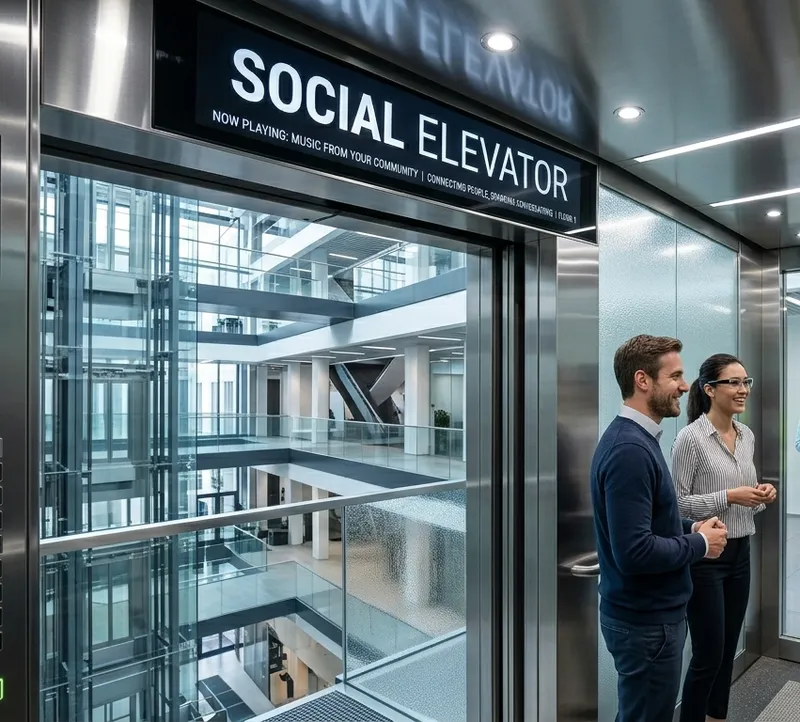
There are moments in history when a door opens wide — not just a crack, but fully, publicly, for everyone. The printing press. The internet. The smartphone. Most people walk past those doors assuming they're not for them. A few walk through and change their lives. We are standing in front of one of those doors right now. It's called vibe coding, and the elevator behind it goes all the way to the top.
What Is Vibe Coding?
Vibe coding is the practice of building software by describing what you want in plain language — and letting an AI write, debug, refactor, and ship the actual code. You don't touch syntax. You don't learn frameworks. You don't memorize language-specific quirks. You describe the intention. The AI handles the implementation.
The term was coined by OpenAI co-founder Andrej Karpathy in early 2025, almost as an offhand observation: you can now describe the "vibe" of what you want — a landing page, a checkout flow, a data pipeline — and an AI agent will produce working software. Within months, it stopped being a meme and started being a movement.
Today, tools like Claude Code, Cursor, Bolt.new, and Lovable let non-programmers ship real products to real users. These aren't toy demos. They are production applications, SaaS products, and internal tools — built by people who could not have written a single line of code two years ago.
Vibe coding doesn't mean thinking less. It means thinking at a higher level. You go from writing lines to writing intentions — and that changes everything.
The shift is not cosmetic. The unit of work has changed from "write this function" to "build this feature." The barrier to entry for software creation — the thing that has separated the technical from the non-technical for fifty years — has effectively collapsed.
Why Vibe Coding Is a Social Elevator
Social elevators are rare. They are the mechanisms that allow someone born in the wrong neighborhood, the wrong country, or the wrong family to rise economically and professionally beyond what their starting point would have predicted. Education was one. The internet was another. Vibe coding is the third — and it may be the most powerful of the three, for three very specific reasons.
The price of entry has never been lower
A computer science degree in the United States costs between $50,000 and $200,000 and takes four years. A coding bootcamp costs between $10,000 and $20,000 and takes six months. These were the previous on-ramps to software creation — the ways a non-programmer could acquire enough skill to build something real.
Claude Pro: $20 a month. Cursor: $20 a month. The tools that now let you build and ship production software cost less than a Netflix subscription. The financial barrier to entering the software economy has gone from "tens of thousands of dollars" to "less than a dinner out." This is not an incremental improvement. It is a structural rupture.
For someone in Lagos, in Bogotá, in Bucharest — someone with a laptop, internet access, and a problem worth solving — the cost of building a product that competes globally is now functionally zero.
The time to productive is measured in days, not years
Learning to code well enough to build a real product used to take two to four years of disciplined study. Not to become a senior engineer — just to get to the point where you could ship something without constant help from others. That timeline compressed dramatically with bootcamps. Vibe coding has compressed it to near-zero.
Someone with a clear product idea and a basic understanding of what they want can go from "I want to build this" to "this is live and users are signing up" in a single weekend. Not a prototype. Not a mockup. A working, deployable product. The immediacy is unprecedented.
This matters enormously for people who cannot afford to spend two years learning before they can execute. Vibe coding removes the waiting period between having an idea and testing whether the market cares about it.
The learning curve has flattened to nearly horizontal
Traditional programming has a brutal learning curve. The first six months are genuinely hard: you are fighting syntax, fighting logic, fighting your own mental model of how computers work. Most people quit. Not because they lack ability, but because the ramp is steep and the feedback loop is slow.
With vibe coding, the feedback loop is immediate. You describe what you want. You see the result. You refine. The skill you're building is not "how to write code" — it's "how to describe what I want with precision." That is a skill every intelligent adult already partially has. It just needed a new surface to apply it to.
The barrier is no longer technical aptitude. It's clarity of thought. And clarity of thought is far more democratically distributed than the ability to memorize C++ syntax.
The Unicorns Are Already Being Born
Here is the part that most people are not taking seriously enough: the next generation of billion-dollar companies is probably already being built by vibe coders right now. Not by teams of fifty engineers in San Francisco — by two people in a flat in Madrid, by a solo founder in Seoul, by a designer who learned to describe software faster than any engineer can write it.
The evidence is already visible. Lovable.dev — a platform that lets you build full-stack applications by describing them in plain English — went from zero to tens of thousands of users within weeks of launch. Bolt.new crossed a million users before most venture capitalists had heard of it. These are not niche tools. They are platforms that have demonstrated that the appetite for vibe coding at scale is real and enormous.
But the more important signal is not the tools — it's what people are building with them. Across X, Product Hunt, and indie hacker communities, a new class of founder is emerging: the vibe founder. No co-founder needed to handle the engineering. No seed round needed to hire a technical team. One person with a clear problem, a paying audience, and access to a $20/month AI agent.
The next unicorns will not be built by larger engineering teams. They will be built by smaller, faster ones — and some of those teams will have exactly one person.
This is not speculation. The structural conditions for it are already in place. The cost of building software has collapsed. The cost of distribution — via social media, App Store, Product Hunt — is near-zero. The only remaining scarce resource is the idea and the drive to execute. That has never been something a credential could provide.
The Productivity Multiplier Is Real and It Is Large
Before we talk about societal implications, let's be precise about the magnitude of what's happening at the individual level. Because it's easy to use vague language like "much more productive" and leave it there. The actual numbers are worth sitting with.
A senior software engineer working traditionally ships roughly 200-400 lines of meaningful code per day. That's not a measure of typing speed — it accounts for thinking, reviewing, debugging, testing, and refactoring. It's a real-world throughput number refined over decades of software project data.
A skilled vibe coder directing an AI agent can produce 2,000 to 5,000 lines of working, tested code per day. That's not a marketing claim — it's what experienced practitioners are consistently reporting in 2026. The multiplier is roughly 10x on output volume, and significantly higher when measured by value delivered rather than lines written.
For a solo founder, this means that what previously required a five-person engineering team can now be built and maintained by one person directing an AI. For a startup, it means the runway that used to last eighteen months now lasts five years. For a large company, it means the product velocity of a team of twenty with the headcount of four.
This is not a productivity improvement. It is a productivity regime change — the kind that only happens a handful of times per century.
The Three-Body Insight: Productivity Is How Civilizations Evolve
Liu Cixin's The Three-Body Problem contains, beneath its science-fiction surface, a deeply serious theory of civilizational progress. The central insight is this: civilizations do not advance linearly. They advance in explosions — sudden leaps triggered by breakthroughs that compound on everything that came before. Between those leaps, progress stalls. When a leap happens, everything changes, and quickly.
The human civilization in the trilogy is remarkable not for any single technology but for its speed of adaptation and its capacity to compound previous gains into new ones. The printing press compounded literacy. Literacy compounded science. Science compounded industrial production. Industrial production compounded computation. Each explosion built on the ruins and tools of the last one.
What vibe coding represents, in this framework, is not a minor increment — it is the beginning of a new compounding cycle. For the first time in history, the bottleneck for creating software is not technical skill. It is imagination. And imagination, unlike syntax knowledge, is something the entire human species has access to.
When you remove a bottleneck that has constrained an entire industry for fifty years, the released energy does not dissipate. It compounds. Every person who can now build software but previously could not is a new node in the global innovation network. Every idea that would have died in someone's head because they couldn't find a technical co-founder now has a path to existence.
The Three-Body Problem's most haunting theme is the question of what happens when a civilization fails to adapt quickly enough to a step-change in its environment. The answer, in the novel, is extinction. The answer in the real world is irrelevance — companies, careers, and entire economic classes that fail to adapt to the new productivity floor get left behind with astonishing speed.
We are not at the end of this transition. We are at the very beginning. The compounding has barely started.
The Elevator Is There. The Door Is Open. Step In.
Let me be direct, because this is the part that matters most.
Social elevators do not stay open forever. They open, they fill, and then the early movers pull up the ladder — not out of malice, but simply because markets establish themselves, moats form, and first-mover advantages compound. The window during which the elevator is open to everyone is always shorter than it looks.
Right now, in 2026, vibe coding is still in its early-adopter phase. The tools are young but functional. The community of practitioners is large but still a fraction of the potential market. The social and professional premium for being someone who can ship software — even via vibe coding — is enormous and growing. And the cost of entry is, as we've established, less than $30 a month.
This means: if you have ever had a product idea and lacked the technical skills to build it, that excuse no longer exists. If you have ever wanted to start a software business but couldn't afford to hire engineers, that constraint no longer applies. If you have ever felt that the technology industry was a club with an entrance exam you hadn't studied for, the exam has been cancelled.
The social elevator is not waiting for you to become a programmer. It is not waiting for you to take a course, earn a certificate, or spend two years learning React. It is waiting for you to have a clear enough idea to describe to an AI, and the discipline to iterate until that idea becomes a product.
That is a remarkably low bar for a remarkably large prize.
The people who will compound the most in the next decade are not the ones who were already technical. They are the ones who recognize this moment for what it is — a genuine, structural, once-in-a-generation shift in who gets to build things — and step into it without waiting for permission.
The elevator is at ground level. The door is open. It has never been this cheap to get on. And it will not stay this way for long.