

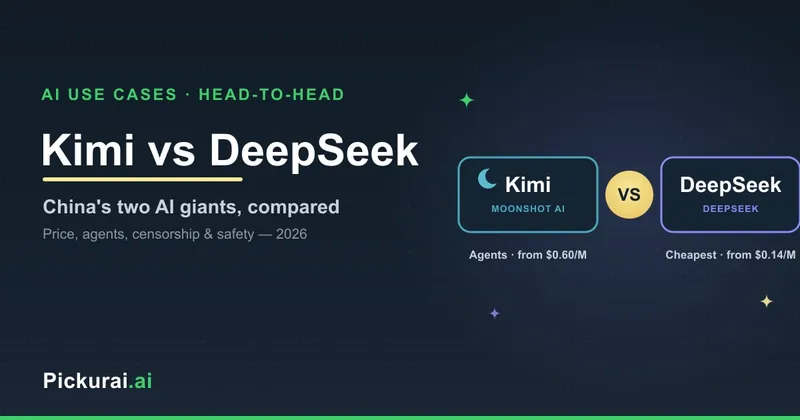
Kimi and DeepSeek are China's two most talked-about AI models. And they're making opposite bets. DeepSeek bets on the model: the cheapest, strongest raw open-weight AI you can buy, frontier-class at a tenth of Western prices. Kimi bets on the product: an autonomous-agent ecosystem (Agent Swarm, Kimi Code) wrapped in a five-tier subscription, with notably lighter censorship. Same country, same open-weight philosophy, very different answer to "what are you paying for." The comparison is below.
- DeepSeek wins on price. V4 Flash $0.14/$0.28 and V4 Pro $0.435/$0.87 per 1M tokens undercut Kimi's K2.5 ($0.60/$3) and K3 ($3/$15) at every tier.
- DeepSeek wins on raw model. V4 Pro (~1.6T MoE) scores ~80% on SWE-bench: top-tier open-weight capability for the money.
- Kimi wins on agents. Agent Swarm (parallel agents), Kimi Code and a real subscription product are its whole identity.
- Kimi censors less. Independent 2026 testing found Kimi filters political topics far less than most Chinese models; DeepSeek censors more.
- Different products: DeepSeek is free chat + a cheap API; Kimi is a tiered $0–$199/mo agent platform.
The Quick Verdict
Pick DeepSeek if you want the cheapest capable API on the market, the strongest raw model per dollar, or a free no-frills chatbot. Pick Kimi if you want autonomous agents and agent swarms, a polished subscription assistant, or the more permissive of the two on sensitive topics. Most developers optimizing for cost land on DeepSeek; most people wanting an agent product land on Kimi.
The Models & Capability
Both are large, open-weight, mixture-of-experts models with 1-million-token context windows: so on the fundamentals they're evenly matched. The difference is emphasis.
DeepSeek ships two current API models: V4 Flash (the cheap, fast tier) and V4 Pro, a roughly 1.6-trillion-parameter MoE that scores around 80% on SWE-bench Verified: genuinely frontier-class on coding, and the strongest open-weight model for the price. DeepSeek's reputation is built on doing more with less compute, and it shows up as raw capability-per-dollar.
Kimi leads with K3 (its July 2026 flagship) plus the cheaper K2.5, K2.6 and coding-tuned K2.7 Code. The models are strong, but Kimi's real differentiator isn't a benchmark. It's the agent layer: Agent Swarm runs many autonomous agents in parallel, Kimi Code is a dedicated coding agent, and Kimi Claw adds browser and cloud automation. Where DeepSeek gives you a great model, Kimi gives you an agent platform built on top of one. (New to it? See what is Kimi?)
API Pricing: DeepSeek Undercuts Across the Board
If you're building on the API, this is the clearest split. Prices per 1M tokens (input / output):
| Model | Input | Output | Cache-hit in |
|---|---|---|---|
| DeepSeek V4 Flash | $0.14 | $0.28 | $0.0028 |
| DeepSeek V4 Pro | $0.435 | $0.87 | $0.0036 |
| Kimi K2.5 | $0.60 | $3.00 | — |
| Kimi K2.6 / K2.7 Code | $0.95 | $4.00 | $0.19 |
| Kimi K3 (flagship) | $3.00 | $15.00 | $0.30 |
DeepSeek is cheaper at every comparable tier. Its budget V4 Flash ($0.14/$0.28) is a fraction of Kimi's cheapest K2.5, and even its premium V4 Pro ($0.435/$0.87) costs less than Kimi's mid model: while matching or beating Kimi's flagship on raw capability. Kimi's K3 sits at $3/$15, the same as Claude Sonnet 5; DeepSeek simply doesn't price anything that high. If your priority is tokens-per-dollar, this table is the whole story. (Run your own volumes through our Token Calculator to see the monthly difference.)
How You Actually Use Them Differs
This is where the "opposite bets" really show, and it's not a like-for-like comparison. DeepSeek is essentially a free chatbot plus a cheap API: the consumer app costs nothing, and monetization happens through those rock-bottom API prices. There's no tiered subscription to climb.
Kimi is a product with a ladder. Its five consumer tiers (Adagio (Free), Moderato ($19), Allegretto ($39), Allegro ($99) and Vivace ($199)) gate agent capability: agent credits, the Kimi Code multiplier (1×–30×), Agent Swarm runs and Kimi Claw. You're not paying for a smarter chatbot as you climb; you're paying for a more autonomous, higher-throughput agent.
DeepSeek asks "how cheap can a great model be?" Kimi asks "how autonomous can we make the assistant?" Your answer to which question matters more is your answer to Kimi vs DeepSeek.
Censorship & Data: The Real Differentiator
Both are Chinese models subject to the same regulatory content rules, so you'd expect them to behave the same. They don't. Independent testing through 2026 found that Kimi censors politically sensitive topics far less than most Chinese models (close to Western assistants on neutrality tests) while some DeepSeek releases censor heavily. If open discussion of China-related topics matters to your use case, Kimi is clearly the more permissive of the two.
On data, both train on your input by default, and the difference is jurisdiction: DeepSeek stores data in China (with an opt-out for training), while Kimi's international platform stores data in Singapore. Neither is a good home for confidential or regulated information. The good news is that both are open-weight, so for sensitive work you can self-host either one and keep the data entirely on your own infrastructure: the same move we recommend across the board in are Chinese AI models safe?
Where Each One Wins
DeepSeek wins on: API price (cheapest capable model, full stop), raw model quality per dollar (V4 Pro is frontier-class), and a genuinely free, no-friction chatbot.
Kimi wins on: autonomous agents (Agent Swarm and Kimi Code have no DeepSeek equivalent), being a polished subscription product rather than just a model, and lighter censorship plus Singapore (rather than mainland) data hosting.
Which Should You Pick?
API developers optimizing for cost → DeepSeek. Nothing capable is cheaper, and V4 Pro gives you near-frontier quality for pocket change. Pair it with our DeepSeek API setup guide to get started.
Agent builders and automation → Kimi. If your work is autonomous agents, swarms or high-throughput coding fan-out, Kimi's whole ladder is built for it.
Free chatbot users → either, leaning DeepSeek. Both have usable free tiers; DeepSeek's is completely free with no upsell, Kimi's free Adagio plan is generous but nudges toward paid agents.
Anyone with sensitive data → neither hosted; self-host, or use Claude. For confidential or regulated work, run the open weights yourself or reach for a Western assistant. See our Kimi vs Claude comparison for the privacy-first angle, and where both sit in the broader 2026 AI API price war.
Still weighing it up for your specific use case? Our free AI picker narrows it down in about 30 seconds.