

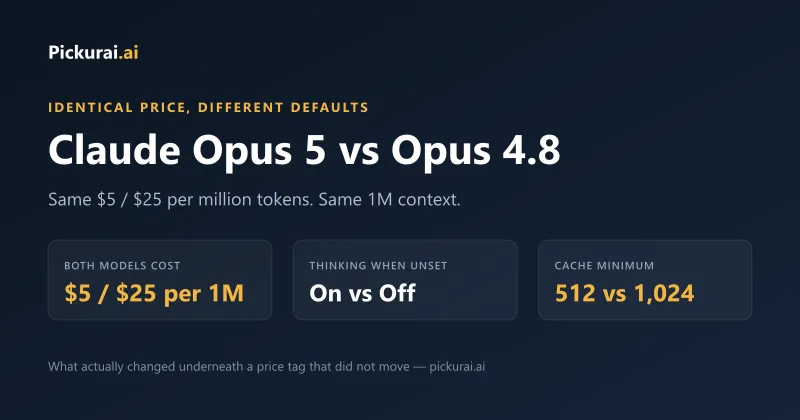
Claude Opus 5 costs exactly what Claude Opus 4.8 costs: $5 per million input tokens and $25 per million output tokens. Same 1M-token context window. Same 128K maximum output. Same feature set — prompt caching, batch processing, vision, PDFs, the full tool surface. That makes this the rarest kind of model upgrade: one with no price argument for staying put.
So the interesting question is not "is it worth the money", because it does not cost more money. The interesting question is what changed underneath a price tag that did not move — and there, four things are worth knowing before you swap the model string.
TL;DR — Key Takeaways
- Price: identical. $5 / $25 per million tokens on both. Fable 5, the tier above, is double that at $10 / $50.
- Specs: identical. 1M context (the default and the maximum on Opus 5), 128K max output.
- Thinking is now on by default. On 4.8, omitting the
thinkingparameter meant no thinking. On Opus 5 it runs adaptive — andmax_tokenscaps thinking plus answer, so tight budgets can truncate. - Prompt caching gets cheaper to qualify for: the minimum cacheable prefix drops from 1,024 tokens to 512.
- Behaviour flips: Opus 5 writes longer, narrates more, verifies its own work unprompted, and delegates to subagents more readily — the opposite of 4.8 on that last one.
- Model ID:
claude-opus-5, no date suffix. Opus 4.8 stays available asclaude-opus-4-8.
What is identical
Start here, because it is most of the picture and it is the part people get wrong when a new flagship lands.
| Claude Opus 5 | Claude Opus 4.8 | |
|---|---|---|
| Model ID | claude-opus-5 |
claude-opus-4-8 |
| Input price / 1M tokens | $5.00 | $5.00 |
| Output price / 1M tokens | $25.00 | $25.00 |
| Context window | 1M tokens | 1M tokens |
| Max output | 128K tokens | 128K tokens |
| Thinking when unset | Adaptive (on) | Off |
| Min. cacheable prefix | 512 tokens | 1,024 tokens |
| Effort levels | low → max (all five) | low → max (all five) |
| Fast mode | Yes — $10 / $50 | Yes |
Both models are available on Anthropic's own API, Amazon Bedrock (where the ID takes an anthropic. prefix), Google Cloud and Microsoft Foundry. Opus 4.8 is not being retired to make room — it stays available on all four. Since the two models share a price, any figure you have already worked out for Opus 4.8 carries over unchanged; the Token Cost Calculator has Opus 4.8 at that same $5/$25 if you want to sanity-check a workload against your current spend.
Difference 1: thinking is on by default — and it can truncate you
This is the change most likely to bite, because it is silent. On Opus 4.8, a request that omitted the thinking parameter ran without thinking. On Opus 5, the same request runs adaptive thinking. Nothing errors; you simply start spending thinking tokens you were not spending before.
The part that actually breaks things is the interaction with max_tokens, which is a hard cap on thinking plus response text together. If you sized max_tokens tightly around the length of an answer on a workload that never used thinking, Opus 5 can now spend a chunk of that budget reasoning and truncate the answer mid-sentence. The fix is either to raise max_tokens or to pass thinking: {"type": "disabled"} explicitly.
Which leads to the second half of this change: disabling thinking is only allowed at an effort of high or lower. Pairing thinking: {"type": "disabled"} with xhigh or max returns a 400 on Opus 5, and that combination was perfectly legal on 4.8. It is validated on every request, so a route that raises effort later in a conversation gets rejected even if earlier calls went through.
Difference 2: prompt caching starts paying off sooner
The minimum cacheable prefix drops from 1,024 tokens on Opus 4.8 to 512 tokens on Opus 5. Below the minimum, a cache breakpoint is silently ignored — no error, just a cache that never gets written.
In practice this means prompts you previously wrote off as too short to cache now qualify, with no code change at all. If you have a system prompt sitting somewhere in the 500–1,000 token range and you gave up on caching it, that decision is worth revisiting: cache reads run at roughly a tenth of base input price. Worth noting that this minimum is not monotonic across the family — Opus 4.6 and Haiku 4.5 both require 4,096 tokens — so it is a per-model number, not a trend line.
An upgrade that costs the same as the model it replaces is unusual enough. The catch is that "free" refers to the price per token, not to the number of tokens Opus 5 decides to spend.
Difference 3: three behaviours reverse direction
This is where prompts tuned carefully for Opus 4.8 will feel off, and where the changes are least intuitive — because several of them run backwards from what the 4.8 upgrade asked you to do.
- Subagent delegation flipped. Opus 4.8 was conservative about spawning subagents and needed explicit encouragement to delegate. Opus 5 reaches for them freely. If you added "delegate more" guidance for 4.8, it should come out — otherwise you are multiplying cost and latency, since every subagent re-establishes context, explores, reports back, and then the coordinator re-reads the report.
- Self-verification is now automatic. Opus 5 checks its own work without being told. Instructions asking it to verify, double-check or re-run a final validation step now cause over-verification. This one inverts standard prompting advice — "ask the model to self-check" is generally sound and is wrong here.
- It writes longer and narrates more. Longer conversational responses, more text between tool calls, and longer files when it writes documents to disk. Lowering
effortdoes not reliably shorten visible output — a short conciseness instruction in the prompt is the lever that works.
There is one more worth flagging for anyone building a user-facing product: Opus 5 also expands task scope more than 4.8 did, adding steps that were not requested. A single sentence telling it to deliver what was asked at the scope intended reins that in.
Difference 4: the operational small print
Three details that matter if you run this at volume rather than in a chat window:
- Rate limits are a separate bucket. Opus 4.8, 4.7, 4.6 and 4.5 share one combined Opus limit. Opus 5 does not draw from it — shifting traffic across neither frees headroom on the old pool nor inherits it. Check your tier's Opus 5 limits before moving volume.
- Safety classifiers can decline a request. Opus 5 ships with elevated cybersecurity safeguards. A declined request returns a normal HTTP 200 with
stop_reason: "refusal"— so code that reads the first content block unconditionally will break. Benign security and life-sciences work occasionally trips them. - Priority Tier does not cover Opus 5. It is supported on Opus 4.8 and on Fable 5, but a Priority Tier request naming Opus 5 fails validation.
Where Opus 5 sits in the lineup
Opus 5 is not the top of the range. Claude Fable 5 remains the highest-capability tier at $10 / $50 per million tokens — double Opus 5's price — aimed at the most demanding reasoning and long-horizon agentic work. Anthropic's own framing puts Opus 5 as the model for complex agentic coding and enterprise work at half of Fable 5's cost, with the largest gains over 4.8 on difficult tasks: multi-file features, larger refactors, end-to-end feature work. On easy single-turn edits the gap narrows considerably, which is worth knowing if that is most of your workload.
One thing I will not do here is put a benchmark table next to the price table. I have verified pricing, context windows, model IDs and API behaviour from Anthropic's own model reference — I have not verified a like-for-like SWE-bench comparison between Opus 5 and 4.8, so I am not going to publish one. When those numbers land from a source worth citing, this page gets updated. In the meantime, the Opus 4.8 one-week review is the honest account of what the previous model felt like in daily use, and it is the baseline I am measuring against.
Should you switch?
Yes, with one afternoon of care. The price is identical, the specs are identical, and Opus 4.8's request surface carries over unchanged — no removed parameters, no new required fields. The work is not migration, it is re-tuning:
- Find every route that never set
thinkingand either raisemax_tokensor disable thinking explicitly. - Find every route that disables thinking at
xhighormaxeffort — those now 400. - Delete verification instructions and any "delegate more" subagent guidance you added for 4.8.
- Add a conciseness line if you care about response length.
- Re-check any prompt in the 512–1,024 token range that you had written off as uncacheable.
Then run an effort sweep. The published starting points are xhigh for coding and agentic work and high elsewhere, but low and medium are unusually strong on this model, and effort defaults carried over from 4.8 are rarely the right setting. That sweep is where the actual cost saving lives — not in the price list, which did not change at all.
Related: my one-week review of Opus 4.8, the earlier Opus 4.8 vs 4.7 comparison, Claude Fable 5 vs Opus 4.8, and Opus 4.8 vs Sonnet 5. Working out what a switch costs? Run it through the Token Cost Calculator.
Common questions
Is Claude Opus 5 more expensive than Opus 4.8?
No. Both are $5 per million input tokens and $25 per million output tokens on Anthropic's first-party API, with the same 1M context window and 128K maximum output. Opus 5 is a drop-in upgrade at the older model's price. The one thing that can raise your bill is that Opus 5 thinks by default, spending output tokens Opus 4.8 did not spend unless you asked for them.
What is the model ID for Claude Opus 5?
It is claude-opus-5, with no date suffix. On Amazon Bedrock it takes the provider prefix — anthropic.claude-opus-5. Opus 4.8 remains available as claude-opus-4-8 everywhere it was before.
Do I need to change my code to move from Opus 4.8 to Opus 5?
Usually just the model string, but check two things. Opus 5 runs adaptive thinking when thinking is omitted, whereas 4.8 ran without it — and since max_tokens caps thinking plus response text together, a tightly-sized budget can truncate mid-answer. Second, combining disabled thinking with an effort of xhigh or max returns a 400 on Opus 5; 4.8 accepted it. Everything else about the request surface is unchanged.
Is Claude Opus 5 better than Opus 4.8?
Anthropic positions it as a step change on deep reasoning, agentic and long-horizon work, with the largest gains on difficult multi-file coding rather than short single-turn edits. Since the two cost the same, there is no price argument for staying on 4.8. The practical caveat is that Opus 5 writes longer and narrates more, so prompts tuned for 4.8's brevity may need a conciseness instruction.
Is Claude Opus 5 the most capable Claude model?
No — Claude Fable 5 is, at $10 per million input and $50 per million output, double Opus 5's rate. Opus 5 is the model for complex agentic coding and enterprise work at half of Fable 5's cost; Fable 5 targets the most demanding reasoning and long-horizon agentic work.