

Anthropic ships two current top-tier Claude models: Opus 4.8, the most capable, and Sonnet 5, the balanced one. If you use Claude every day, the real question isn't "which is best" — it's "which one should I reach for, and when?" Because on a Claude Pro or Max plan you get both, and on the API the choice comes down to a genuine trade-off between capability and cost.
Here's the short version: Sonnet 5 is the smart default and Opus 4.8 is the ceiling. Sonnet 5 gives you near-Opus quality on coding and agentic work for roughly 40–60% less, while Opus 4.8 is the model you keep in your back pocket for the genuinely hard, long-running, high-stakes tasks where the quality difference actually shows up.
Key takeaways
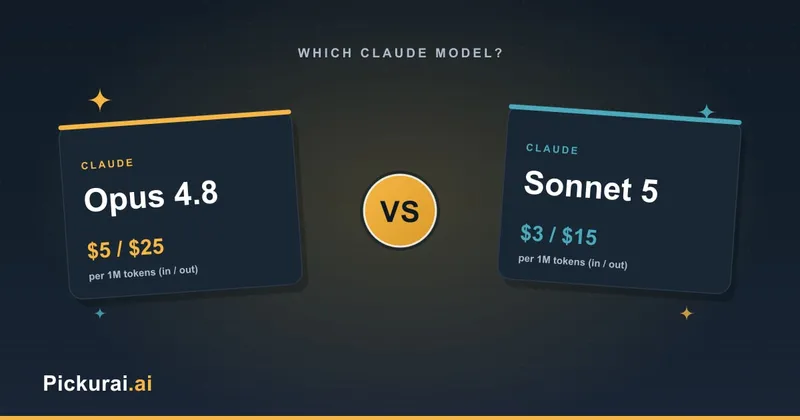
- Opus 4.8 is Anthropic's most capable model — best for the hardest reasoning, long-horizon agentic runs and knowledge work. $5 / $25 per million tokens (input / output).
- Sonnet 5 reaches previously-Opus-tier quality on coding and agentic tasks, faster and cheaper. $3 / $15 per million — dropping to $2 / $10 on introductory pricing through Aug 31, 2026.
- Both share a 1M-token context window, 128K max output, the same tokenizer, adaptive thinking and effort levels up to
max. - On claude.ai, both are included in one Pro or Max subscription — switching costs nothing. On the API, the price gap is the whole decision.
We'll break down the spec sheet, then give the opinionated take on which model fits which kind of user.
Opus 4.8 vs Sonnet 5: Side-by-Side
API pricing is per million tokens. Both models are available on claude.ai (Pro/Max), the Anthropic API, and Claude Code.
| Dimension | Opus 4.8 | Sonnet 5 |
|---|---|---|
| Tier | Flagship (most capable) | Balanced (speed + intelligence) |
| Input price / 1M | $5 | $3 |
| Output price / 1M | $25 | $15 |
| Intro price (to Aug 31, 2026) | — | $2 / $10 |
| Context window | 1M tokens | 1M tokens |
| Max output | 128K tokens | 128K tokens |
| Adaptive thinking | Yes (opt-in) | Yes (on by default) |
| Effort levels | low → max | low → max |
| Best at | Hardest reasoning, long agentic runs, memory | Coding + agentic at speed, high volume |
| On claude.ai (Pro/Max) | ✅ | ✅ |
Two things jump out. First, the spec sheet is almost identical — same context window, same output ceiling, same thinking and effort controls. Second, the one big difference is price, and it's a big one: Sonnet 5 is 40% cheaper at standard rates and up to 60% cheaper during its introductory window. That's the whole story of this comparison in a nutshell.
Model Summaries
Claude Opus 4.8 — The Capability Ceiling
Opus 4.8 is Anthropic's most capable model. It's built for the work at the top of the difficulty curve: long-horizon agentic execution (think overnight coding runs and complex, multi-file refactors that complete without hand-holding), deep multi-step reasoning, knowledge work, and better use of file-based memory across a long session. Testers consistently describe its writing as clearer and warmer than the previous generation, and it's a stronger thought partner — more willing to push back and infer the right answer from context.
Where it earns its price is reliability on hard problems. When a task is genuinely difficult, Opus 4.8's higher capability ceiling means fewer wrong turns, fewer retries, and less of the "it said it was done but it wasn't" behaviour that costs you time on autonomous work. That reliability is invisible on an easy prompt and decisive on a hard one.
API price: $5 input / $25 output per million tokens. 1M-token context window at standard pricing (no long-context premium), 128K max output. Available on claude.ai's paid plans, the API, and as the top tier in Claude Code.
Claude Sonnet 5 — Near-Opus, For Less
Sonnet 5 is the balanced tier, and its headline is that it reaches what was previously Opus-tier quality on many coding and agentic tasks. For the vast majority of real work — everyday chat, drafting, analysis, the coding you do in a normal day — you would struggle to feel a difference against the flagship, and you'd pay noticeably less to not feel it.
It has a couple of Sonnet-5-specific traits worth knowing. Adaptive thinking is on by default (on Opus you opt in), so it reasons when a task warrants it without you configuring anything. It's the first Sonnet-tier model to support the xhigh effort level, which closes much of the remaining gap on demanding coding. And it ships high-resolution vision, so screenshots, charts and documents come through sharper.
API price: $3 input / $15 output per million tokens, dropping to $2 / $10 on introductory pricing through August 31, 2026. Same 1M context window and 128K output as Opus 4.8.
The Cost Difference, Made Concrete
The most important nuance most comparisons miss: Opus 4.8 and Sonnet 5 use the same current-generation tokenizer. That means a given prompt costs the same number of tokens on both models — there's no hidden "the cheaper model quietly uses more tokens" catch. The price gap you see on the spec sheet is exactly the price gap you pay.
So at standard rates, running the same workload on Sonnet 5 costs about 40% less than on Opus 4.8. During Sonnet 5's introductory pricing that stretches to roughly 60% cheaper. For anything high-volume — a production app, a batch job, an agent that runs all day — that difference compounds fast, and it's the single strongest argument for defaulting to Sonnet 5 and only escalating to Opus 4.8 when a task actually needs it.
On claude.ai, none of this applies to your wallet directly: a Pro subscription ($20/month) or a Max plan includes access to both models, and you switch between them from the model picker at no extra cost. The economics only bite when you're paying per token on the API. Want to see what either model would cost on your real usage? Run the numbers through our AI Token Cost Calculator before you commit to an API budget.
Biggest Advantage and Disadvantage of Each
Claude Opus 4.8
Biggest advantage over Sonnet 5: the capability ceiling on hard, long-running work. On complex autonomous tasks — a large refactor, a first-shot build of a non-trivial system, tricky debugging where an intermittent flake needs to be correctly identified rather than papered over — Opus 4.8 is more reliable and needs fewer corrections. When you're not checking every step, that reliability is worth more than the token savings.
Biggest disadvantage: it costs 40–60% more per token, and on everyday tasks that premium buys you very little you'd actually notice. Paying Opus rates to answer emails, summarise a doc, or write a simple function is spending flagship money on work Sonnet handles just as well.
Claude Sonnet 5
Biggest advantage over Opus 4.8: price-to-quality. You get near-Opus performance on the bulk of coding and agentic work for a fraction of the cost, plus adaptive thinking on by default and high-resolution vision. For high-volume production and normal day-to-day use, it's simply the more economical choice — and often you can't tell it apart from the flagship.
Biggest disadvantage: on the genuinely hardest problems it doesn't quite match Opus 4.8's ceiling. For long autonomous runs, deep reasoning chains, or high-stakes work where a wrong answer is expensive, the extra reliability of the flagship can be worth more than the savings — and that's exactly the gap Opus 4.8 exists to fill.
A Note for Developers and API Users
If you're building on the API rather than chatting on claude.ai, a few practical points. Both models support the full effort range (low through max, including xhigh), and for demanding coding or agentic work xhigh is the recommended setting on either. Adaptive thinking is on by default on Sonnet 5; on Opus 4.8 you set it explicitly. Both share the 1M-token context window and 128K max-output ceiling, so streaming is the right call for large responses.
The pragmatic architecture most teams land on is a two-model setup: Sonnet 5 as the default workhorse for the high-volume path, with Opus 4.8 reserved for the hard sub-tasks where quality matters most. And for the simplest, latency-critical calls — classification, quick lookups, cheap transforms — Haiku 4.5 ($1 input / $5 output per million, 200K context) is cheaper still. Just setting up API access? Our Anthropic API beginner's guide walks through keys, model IDs and a first request.
Which One Should You Choose?
Choose Sonnet 5 if: You want the best value in the Claude line-up. You do a lot of everyday chat and coding, you're running anything high-volume on the API, or you're cost-sensitive and want near-Opus quality without flagship pricing. For most people, most of the time, this is the right default.
Choose Opus 4.8 if: You regularly hit genuinely hard problems — long autonomous agent runs, deep reasoning, complex multi-file work, or high-stakes tasks where a wrong answer is costly. You value the highest reliability ceiling and the fewest retries, and the extra cost is justified by the quality of the outcome.
The honest take: for most Claude users this isn't really an either/or. If you're on claude.ai, your Pro or Max plan already includes both — so the smart move is to make Sonnet 5 your default and flip to Opus 4.8 only when a task is clearly hard enough to warrant it. If you're paying per token on the API, start on Sonnet 5 and escalate to Opus 4.8 for the sub-tasks that need the ceiling. Either way, you're choosing a lever, not a loser: both are excellent, and the difference is capability-versus-cost, not good-versus-bad. Weighing Claude against the other big assistants entirely? See our ChatGPT vs Claude vs Gemini head-to-head, or let Pickurai's free wizard point you to the right tool in six questions.