

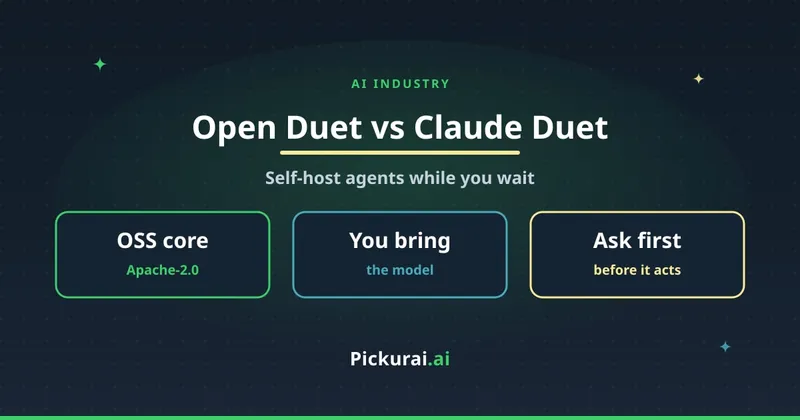
I live in Spain and I still cannot open Claude Duet. The preview wants a US Claude account, a Pro, Max or Ultra seat, and an invitation with no date on it. I wrote that up in Claude Duet vs ChatGPT dots vs Meta Muse. While that waitlist sat there, an open-source project named Open Duet has passed 6,600 GitHub stars since its first commit on 29 September. It is not Anthropic. It does not ship a model. It does let you name agents, give them memory and routines, and force an approval before they change anything. That is the product people keep calling a Claude Duet alternative, and the bill is different from a sticker price that says free.
Checked 3 November 2026
- What it is. Anil-matcha/open-duet is an Apache-2.0 workspace for named agents with roles, memory, isolated workspaces, routines (cron, webhook, or manual), and approval modes (Ask first, Accept edits, Plan only). A lead can hand work to specialists. Stars on the API today: 6,632; forks: 833; last push this morning.
- What it is not. It is not affiliated with Anthropic. It does not include a model or a model subscription. You connect Claude Code, Codex CLI, Gemini CLI, Cursor, ACP, OpenRouter, Ollama, LM Studio, or another OpenAI-compatible API.
- How you run it. Desktop from a source checkout (Node.js 22+, uv, an engine), self-host on Linux with HTTPS plus Docker or Node/uv, or use the separate hosted product at suparagent.ai.
- Wrong repo trap.
CopilotKit/OpenDuet(~1,874 ★) andbrowser-use/open-duet(~504 ★) are different projects. CloneAnil-matcha/open-duet.
Claude Duet vs Open Duet vs ChatGPT dots
I care about four things from Spain: can I open it today, who pays for the model, how much control do I keep before it acts, and how mature the thing is. The table below is from Anthropic's Duet pages, OpenAI's dots pages, and the Open Duet README, all read on 3 November 2026.
| Claude Duet | Open Duet | ChatGPT dots | |
|---|---|---|---|
| Where it runs | Anthropic cloud app (iOS, Android, claude.ai) | Your desktop, your server, or Suparagent hosted | OpenAI cloud computer inside ChatGPT |
| Access today | US Claude Pro, Max or Ultra + waitlist invitation | Clone the repo or open a Suparagent account | Pro / Business Premium; EEA, UK, Switzerland excluded for Pro |
| Who pays the model | Your Claude Pro, Max or Ultra limits (Opus 5.5 only) | Whatever engine and provider account you connect | Chat with the dot sits outside ChatGPT limits; Work/Codex tasks count |
| Approval before acting | Asks before send/pay; no browser takeover | Ask first, Accept edits, or Plan only; routines never self-approve | Permissions per action; research stays read-only until you allow more |
| Maturity | Vendor research preview | Active OSS, experimental; self-host is single-owner | Gradual rollout inside ChatGPT |
Claude Duet and dots details match our earlier comparison. Open Duet rows come from the project README on 3 November 2026. None of the three is a finished multi-tenant team product for a company of fifty people.
What Open Duet actually gives you
Open Duet is a workspace, not a chat window with a new model name. You create agents with a name, a role, an engine, a workspace folder, memory, and an approval setting. A lead can delegate to specialists, and team leads that use Claude or Codex can coordinate that handoff. Agents keep notes between chats, you can edit what they remember, and routines can fire on a schedule, a webhook, or by hand. Every routine result still waits for you; the README is explicit that a routine never approves an action by itself.
The Today view pulls approvals, questions, routine outcomes, engine failures, and due tasks into one place. You can connect GitHub, Gmail, and Google Calendar through your own Composio key, then grant that access to selected Claude or Codex agents, with changes waiting for approval. There is an MCP marketplace for individual tools, a task board, a calendar, skills (instruction packs you attach to a message), and templates. A phone app can pair with your own server to chat, stop an answer, or allow or deny a tool call, though that phone path is source-only and has been tried on an Android emulator, not on a store build.
That is the same shape of product as Claude Duet: named coworker, memory, background work, human gate. The difference is ownership. Duet runs on Anthropic's cloud and spends your Claude plan. Open Duet runs where you put it and spends whatever engine you wired in. Plans that let you choose the model are the reason I left a locked Claude seat for Cursor in the first place; Open Duet keeps that picker on the table.
Install checklist that matches the docs
The desktop path is the one the README puts first. It is still experimental. Unsigned installers exist on Releases for some builds; the assisted update flow verifies a SHA-256 and then asks you to open the installer. It does not update itself in the background.
- Install Node.js 22 or newer and uv.
- Install and sign in to at least one engine on the same machine (Claude Code or Codex CLI are the ones that unlock team leads and connected apps), or plan to add an API engine under Settings → Engines.
- Clone the right repo:
git clone https://github.com/Anil-matcha/open-duet.git, thencd open-duet/desktopandnpm run app. - On first launch, pick an engine, a workspace folder, and an approval mode. Leave Ask first on until you trust the agent.
- Create one agent with a clear job. Chat once. Only then add teammates or a routine.
Self-hosting needs a Linux server, HTTPS, Docker or Node/uv, and the same engine story. The README calls self-host experimental and intended for one owner with paired devices, not a multi-user organization. Docker is only required for the optional isolated agent computers. Development checkouts follow docs/SETUP.md.
What “free” actually costs
The open-source core has no license fee. Inference still costs money unless you point every agent at a local model that fits your machine. Hosted Suparagent is a separate product: you pay Suparagent for compute (or Boat on the free preview), and you still pay your AI provider for tokens. I checked suparagent.ai/pricing and the README table on 3 November 2026. The README lists these hosted plan cards; confirm them on the pricing page before you pay, because the page loads its catalog live.
| Plan | Suparagent / month | Included running compute | Machine disk |
|---|---|---|---|
| Free preview | $0 | Billed to your Boat account | Small profile |
| Starter | $15 | 100 hours / period | 51 GB |
| Standard | $49 | 300 hours / period | 51 GB |
| Pro | $99 | 720 hours / period | 111 GB |
Compute hours count while the sandbox is running. The hosted machine stops after 15 minutes of inactivity, but those idle minutes still count. At the limit the workspace stops until renewal or a plan change; the docs say compute overages are not charged. When a paid plan ends, export files before the provider's disk retention window (the pricing page names 14 days).
Self-host when you already have a machine that stays on, you want the data on disk you control, and you are fine being the only owner. Your bill is electricity or a VPS plus the model.
Suparagent Starter or Standard when you want the agents reachable without babysitting a home server, and you can live inside 100–300 running hours a month. Pro is for heavy routine load. In every hosted case the model invoice is separate, so a cheap Suparagent plan with Opus-class usage is still an expensive month. Put your own numbers through the token calculator, and read API versus subscription if you are choosing between a seat and metered calls.
Do not clone the wrong Open Duet
GitHub search for “open duet” returns more than one hit. On 3 November 2026:
- Anil-matcha/open-duet — 6,632 stars, Apache-2.0, the agent workspace this article covers.
- CopilotKit/OpenDuet — about 1,874 stars, a different codebase.
- browser-use/open-duet — about 504 stars, also different.
If a tutorial omits the owner, stop and check the URL. Installing the wrong tree wastes a day and then you wonder why the README does not match the screenshots.
Who should wait
Skip Open Duet for production-critical automations that must not fail silently. The project itself labels desktop, self-hosting, agent computers, and team features as evolving. Connected apps are reached through Composio and, per the README, have been tested against a fake Composio service rather than the live one so far. Team delegation needs Claude or Codex on the lead. Self-host is single-owner; if you need five people with separate accounts on one deployment, this is not that product yet.
If you already have Claude Duet access in the US and you are happy spending the same Pro, Max or Ultra pool on background checks, stay on Duet until you need a model picker or data on your own disk. If you are in Spain and the waitlist will not help, Open Duet is the path that actually opens. Keep Ask first on. Start with one agent and one folder. Add routines only after a manual run looks right.
For trimming the plans you already pay for, how I manage AI plans is the longer habit piece. For the coding loop that sits next to an agent workspace, vibe coding with Claude Code is the hands-on guide.
Sources:
- Anil-matcha/open-duet README (features, ways to run, hosted plans, limitations, license), checked 3 November 2026.
- Suparagent pricing, checked 3 November 2026.
- Anthropic: Claude Duet product page (for the waitlist and US-preview comparison).
- OpenAI: dots announcement, getting started with your dot and ChatGPT Learn on dots (for the dots column).