

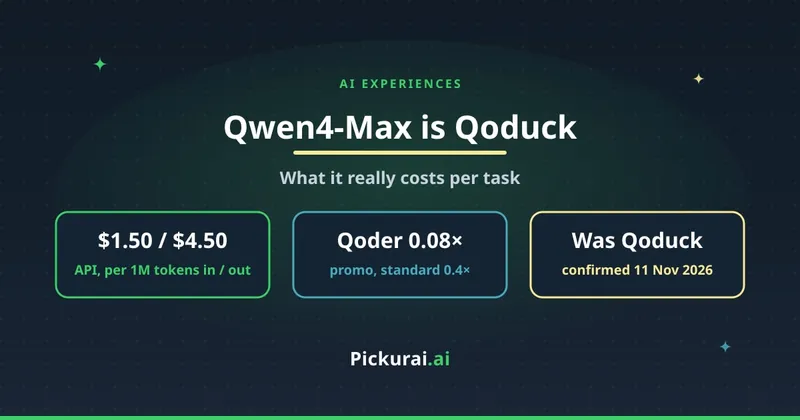
Nine days ago I wrote about Qoduck, the free stealth model in Qoder, and the question everyone on X was asking: is it Qwen 4? On 11 November Qoder answered it in a LinkedIn post: "The mask is off. Qoduck is now Qwen4-Max-Preview." On Monday 16 November Alibaba released the final model, Qwen4-Max, with a price list.
A name and a price are what I said I was waiting for. So this is the follow-up: what Qwen4-Max costs on the API, what it costs inside Qoder now that the free period is over, and what three normal jobs cost next to Gemini 4 Hydrogen, which has the same input price. I haven't run Qwen4-Max on my own projects yet, so there are no test results from me here. The numbers come from Alibaba's and Google's official pages, read on 17 November 2026, and every sum shows its formula.
Short version: on the API, Qwen4-Max costs $1.50 per million input tokens and $4.50 per million output tokens, flat across its 1M-token context. That's the same input price as Gemini 4 Hydrogen and 40% less on output. In an agent loop the cache does most of the work: the same 40-step session costs about $1.50 with the cache and $9.84 without it. In Qoder it bills at 0.08× credits during a promotion with no end date, down from a standard 0.4×. It is not open source.
From Qoduck to Qwen4-Max in nine days
The dates matter if you read anything about this model written last week, because a lot of it describes the preview, not the final release.
- 7 November: Qoder starts giving away a daily allowance of an unnamed "stealth model" called Qoduck. Individual accounts only. Its FAQ says the model's identity "has yet to be disclosed".
- 11 November: Qoder says Qoduck is now Qwen4-Max-Preview, at 0.1× credits instead of 0.5×. QwenCloud's model changelog lists the preview that day as "available through Token Plan only", with no pay-per-token price.
- 16 November: Alibaba announces Qwen4-Max. It goes on sale on the API, in the Token Plan, and in Alibaba's own apps QwenWork and QwenStudio. Qoder switches to the final model the same day.
So the guess in my first piece turned out right, and the "1M context" claim from X turned out right too. If an article tells you Qwen4-Max has no API price or no published context size, it was written about the preview.
The official spec sheet
From QwenCloud's Qwen4-Max page and Alibaba's announcement, checked on 17 November 2026:
| Item | Qwen4-Max |
|---|---|
| Input price | $1.50 per million tokens |
| Output price | $4.50 per million tokens |
| Cached input | $0.075 per million (implicit cache hit or explicit cache read) |
| Writing to the explicit cache | $1.875 per million to keep it 5 minutes, $3 per million for 1 hour |
| Context window | 1M tokens. Up to 991K in and 131K out per request; in thinking mode 983K in and 262K out |
| Input and output | Text, images and video in; text out |
| Size | Mixture-of-experts, 2.4 trillion parameters, 71 billion active per token |
| API | Works with OpenAI-style and Anthropic-style clients. Function calling, structured outputs, web search, batch and fine-tuning |
Two terms in that table carry the price. The context window is how much text the model can take in one request: 1M tokens is several hundred thousand words. Mixture-of-experts means the model only uses part of itself for each token, 71 billion of its 2.4 trillion parameters here, which is how Alibaba keeps a very large model cheap to run.
One thing QwenCloud's page doesn't show is a long-prompt tier. The price is the same at 10K tokens and at 900K. That matters more than it sounds. In my comparison of Muse Ember, Haiku 5.5 and GPT-6 Luna, the thresholds where every token gets more expensive were what made three identical price tags turn into three different bills.
Alibaba also says that on Work360, its own benchmark of industry tasks, Qwen4-Max uses 35% fewer tokens than Qwen3.8-Max at high reasoning effort and costs about 60% less per task. That's the maker grading its own model on its own test. I'd treat it as a claim until someone independent measures it.
What three jobs cost: Qwen4-Max vs Gemini 4 Hydrogen
Gemini 4 Hydrogen is the fair comparison. Google released it on 12 November as its everyday model for coding and agents, it also has a flat 1M-token context, and its input price is the same $1.50. According to Google's pricing page, output is $7.50 per million, thinking tokens included, and cached input is $0.075, implicit cache only.
The formula is the same in every example: input tokens × input price + cached tokens × cached price + output tokens × output price, with prices per million tokens. These count visible tokens. Both are reasoning models, and reasoning tokens are billed as output on top, so a model that thinks longer costs more than these sums show. I've added Muse Ember, Meta's small agent model at $0.10 / $0.50 with cached input at $0.004, as a reminder of what the cheap tier costs.
1. One big refactor: 200K tokens in, 20K out. You hand the model a large part of a repo and ask for a change across many files.
- Qwen4-Max: 200,000 × $1.50 + 20,000 × $4.50 = $0.30 + $0.09 = $0.39
- Gemini 4 Hydrogen: 200,000 × $1.50 + 20,000 × $7.50 = $0.30 + $0.15 = $0.45
- Muse Ember: 200,000 × $0.10 + 20,000 × $0.50 = $0.02 + $0.01 = $0.03
2. Long output: 10K tokens in, 30K out. A long report, a full test suite, a big migration script. Here the output price decides.
- Qwen4-Max: 10,000 × $1.50 + 30,000 × $4.50 = $0.015 + $0.135 = $0.15
- Gemini 4 Hydrogen: 10,000 × $1.50 + 30,000 × $7.50 = $0.015 + $0.225 = $0.24
3. An agent session: 40 steps, each resending a 150K prefix plus 5K of new text, 3K out. This is what a coding agent does all day. It sends the same system prompt, tool list and files on every step, plus a little new text. I assumed the first step pays full price and the other 39 hit the cache.
- Qwen4-Max, first step: 155,000 × $1.50 + 3,000 × $4.50 = $0.246. Each later step: 150,000 × $0.075 + 5,000 × $1.50 + 3,000 × $4.50 = $0.032. Session: $0.246 + 39 × $0.032 = about $1.50
- Gemini 4 Hydrogen, first step: 155,000 × $1.50 + 3,000 × $7.50 = $0.255. Each later step: $0.041. Session: about $1.86
- Muse Ember, first step $0.017, later steps $0.0026. Session: about $0.12
Without the cache, the same Qwen4-Max session is 40 × $0.246 = $9.84. That's more than six times the cached cost, and it's the biggest number in this article. If your agent framework changes the start of the prompt on every step (a timestamp, a shuffled tool list), the cache stops matching and you pay the $9.84 version. Alibaba's implicit cache is automatic but not guaranteed. The explicit cache costs $1.875 per million to write, 25% more than normal input, once, and then $0.075 on every read. It pays for itself from the second step.
So against Hydrogen, Qwen4-Max is cheaper on everything that produces text, by 40% per output token, and the same on everything it reads. Against the cheap tier it is a different product: ten to fifteen times the price for the same job. Use the cheap model for routing and small tool calls and save the big one for the hard steps. To run the same sums with your own monthly usage, Qwen4-Max and Gemini 4 Hydrogen are both in the token calculator.
What it costs in Qoder now
Qoder's offer page, Qwen4-Max Launches with 80% Off for a Limited Time, read on 17 November:
- Standard rate: 0.4× credits. Qoduck's standard rate was 0.5×, so the final model is cheaper than the stealth one was after its free cap.
- Promotion: 0.08× from 16 November at 17:00 Singapore time (10:00 in Spain). The end date "will be announced separately".
- The 0.1× you may see: some Qoder apps round the multiplier and show 0.1×. Qoder says billing uses 0.08× and the display is a bug it's fixing. The preview promo really was 0.1× (from 0.5×), which is why both numbers are going around.
- Who gets it: all Qoder Global users, Free accounts included, and this time Teams and Enterprise too. Qoduck excluded both.
- Which apps: Qoder, Qoder IDE, the JetBrains plugin, Qoder CLI, Cloud Agents, Mobile and Web. Qoduck's promo left the IDE, JetBrains and the CLI out.
- What isn't covered: some Qoder features call a different model in the background, and those calls bill at that model's rate.
This is not free. The Qoduck promo was 0.0× inside a daily cap. Qwen4-Max at 0.08× spends credits on every request, just few of them. Qoder still doesn't publish how many credits one request costs at 1×, so I can't turn 0.08× into euros per task. What I'd do: note your credit balance, run one real task, and check the balance again. That one number tells you more than the multiplier.
What we don't know yet
- Open weights. Qwen4-Max is not open source. Alibaba says smaller open-weight models from the Qwen4 series "will soon be released". No date, no sizes.
- When Qoder's 0.08× ends. Not announced. Plan for 0.4×, five times more.
- Independent cost-per-task numbers. Alibaba cites its own Work360 benchmark and a 6th place on Code Arena. I haven't found an independent cost-per-task measurement for the final model yet, like the Artificial Analysis numbers I used for Muse Ember.
- How much it thinks. Reasoning tokens are the hidden part of the bill. Until someone measures them on the same tasks, the sums above are the floor, not the total.
Who should try it
If you're on Qoder, try it this week on a real task, including from the CLI or JetBrains now that they're covered. 0.08× is the cheapest this model will be. If you build on the API and you're already paying for Gemini 4 Hydrogen, run the same eval on Qwen4-Max: same input price, cheaper output, same context size. The question is only whether it does your work as well. If your agent's bill is mostly a long, repeated prompt, fix your caching before you switch models. In example 3 the cache saves more money than any model change does.
I'll add my own run here when I've done one. If you're not sure which AI tool fits how you work and what you want to spend, our form asks six questions and gives you a short list. And if you want the full picture of what a project costs beyond tokens, I added mine up in the real cost of building a project with AI.