

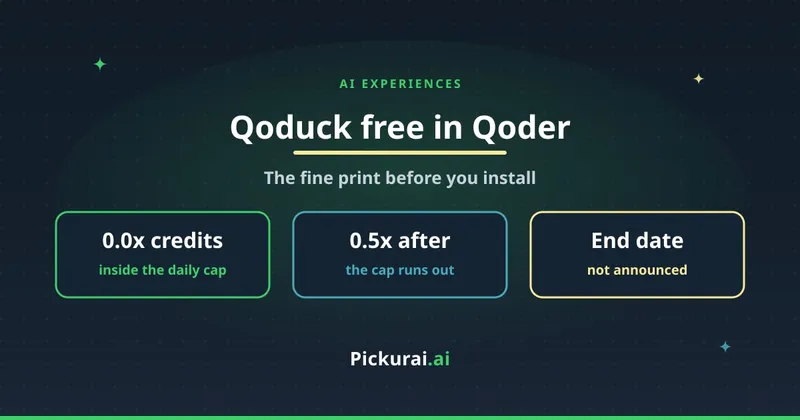
On Saturday 7 November, Qoder, Alibaba's AI coding product, started a promotion for a "stealth model" called Qoduck: a daily free allowance for individual users, for a limited time. By Sunday my X feed was full of it: threads calling it Qwen 4, a "1M context" claim, and posts promoting a crypto token with the same name.
I build side projects in the evenings after a nine-to-five, and I already pay for one coding tool. A free model is tempting. A free model that needs another app, another account and a promo with no end date is a different question. So before installing anything, I read Qoder's own promo page line by line. This is what it says, what it doesn't say, and what I'd check in the first fifteen minutes.
Short version: if you code alone on a personal account, Qoduck costs nothing inside a daily cap that Qoder doesn't publish. Teams and Enterprise accounts can't see it. Nobody has confirmed what model it is. When the cap runs out, Qoduck bills at its standard 0.5× credit rate. Try it on a side project. Don't move your workflow onto it.
What is actually free
The source is the promo page in Qoder's docs, Qoduck: Try the Stealth Model Free for a Limited Time, which I read on 8 November 2026. Qoder says it may change the cap or the dates and will post changes on that page, so check it before you rely on anything below. All times in it are Singapore time (UTC+8), seven hours ahead of Spain right now.
| Question | What Qoder's page says |
|---|---|
| Start date | 7 November 2026. End date "yet to be determined", announced in advance. |
| Who gets it | Individual accounts on Qoder International: Free, Pro Trial, Lite, Pro, Pro+ and Ultra. Free accounts and accounts with zero credits count. |
| Who doesn't | Teams and Enterprise. Qoduck doesn't even show in their model picker. |
| Which apps | Qoder International. The page says Qoder IDE, the JetBrains plugin, Qoder CLI and "other products" don't support the promo for now. |
| Price inside the cap | 0.0× credits, even at the highest thinking setting. It doesn't touch the 100 general-purpose credits you can claim each day. |
| Size of the cap | Not published. "A limited number of free uses each day", more on paid plans. Resets daily. |
| After the cap | Keep going at the standard 0.5× credit rate, switch model, or wait for tomorrow. |
| How to turn it on | Nothing to claim. Update Qoder and pick Qoduck in the model picker. |
Two lines in that table matter more than the rest.
The first is the app line. "Qoder International" is the product the promo names, and the page then says Qoder IDE, the JetBrains plugin and the CLI are not included. Several posts on X say Qoduck is "in the Qoder IDE", which is not what the promo page says. If you live in the terminal or in IntelliJ, this promo isn't for you yet. If you update Qoder and Qoduck isn't in the picker, check that you're in Qoder International on an individual account: the promo page says Teams and Enterprise accounts don't see it.
The second is the cap. "Free" here means free up to a number Qoder hasn't told anyone. You find out where it is when the app tells you today's free uses have run out. That's fine for a test. It's a bad base for a deadline.
Is Qoduck Qwen 4?
Qoder has not publicly confirmed its identity. Qoder's FAQ says Qoduck "is a stealth model whose identity has yet to be disclosed" and that more will be shared "at an appropriate time". That's the only official line.
Here's what is evidence and what is guessing:
- Official: Qoder calls Qoduck "a stealth model whose identity has yet to be disclosed".
- Reported: the Qwen team teased its next flagship family around the same time, according to GEroundtable. That timing is why people connect the two.
- Guess: that it's Qwen 4. Plausible, unconfirmed. Alibaba hasn't said yes or no.
- Not on the official page: the "1M token context" and the "beats Opus" claims going around X. Maybe true, maybe not. Qoder's promo page doesn't mention a context size or any benchmark.
For choosing a tool, the name matters less than people think. What you need to know is whether it fixes your bugs in your codebase. The name will come out, and the free period will end. Plan for both.
What it costs when the free part runs out
After the daily cap, Qoduck bills at 0.5× credits. That sounds cheap, but Qoder's promo page doesn't say how many credits one request costs at 1×, so I can't turn 0.5× into euros per task. What I can see on Qoder's pricing page (8 November 2026): paid plans start at $10 a month, an add-on pack is $20 for 1,500 credits and expires after a month, and first-time users get a 14-day Pro trial with 300 credits. Unused monthly credits don't roll over.
The question I ask before adding any tool is the one I wrote about in managing AI plans like any other expense: does this replace something I pay for, or does it sit on top? A free daily allowance sitting on top of what you already pay costs nothing. Moving your daily work to it and then paying for credits when the cap hits, on top of your current plan, is how the bill creeps up. I added up what a full project really cost me in the real cost of building a project with AI. That's the number to compare against, not "free". If you want to see what your own usage would cost per token on other models, the token calculator does the maths.
Three things to watch out for
The crypto token. I've seen X posts promoting a token with the same name. Qoder's promo page mentions no token, no wallet and no airdrop: the offer "applies automatically with no claim required", so the promotion doesn't need a wallet or a token purchase.
Copy-paste promo posts. A lot of the X posts repeat the same three bullets, often with the 1M context claim. Treat them as ads. The promo page is the source.
Sharing access. Qoder's rules forbid relaying, reselling or sharing access with third parties, and say it can restrict or suspend accounts if it suspects misuse. Keep it to your own account. The Pro trial is also limited to one account per person, and Qoder says extra trial accounts get suspended.
One more, which is my own rule, not Qoder's: an unnamed model is still a model whose provider you can't fully assess. I'd keep it on side projects and public code, and keep client or employer code where your contract already says it can go.
The 15-minute test I'd run before trusting it
I haven't run this yet, so there are no results from me here. This is the checklist I'd use, and you can use it too. The point is to compare Qoduck with the model you already pay for, on the same small task, instead of with someone else's demo.
- Pick one real, small task from your backlog: a bug with a clear repro, or a small feature in one or two files. Write the prompt once and save it.
- Run it on your current tool first and note three things: did it work first time, how many follow-ups it needed, how long it took.
- Update Qoder, pick Qoduck, open the same repo at the same commit and paste the same prompt.
- Check the diff, not the chat. Run your tests. Read every changed line. Count follow-ups.
- Try it at a busy hour too. Qoder warns that responses may slow or queue at peak times. Note the time you ran it.
- Write down where the cap hit, if it did. That's the only way to know what "free" means for your plan.
If Qoduck wins on your task, good: use the free allowance for that kind of work while it lasts. If it ties, keep what you have and check again when the model gets a real name and a real price.
Who should try it
If you code alone on an individual Qoder International account, yes, try it. It costs you an install and fifteen minutes. If you're on a Teams or Enterprise plan, you won't see it. If your work runs through the CLI or JetBrains, wait until Qoder says those are covered. And if you're choosing your main coding AI for the next year, don't choose it based on a promotion with no end date. Switching tools costs more time than the money a free month saves.
If you're not sure which AI tool fits how you work and what you want to spend, our form asks six questions and gives you a short list.