

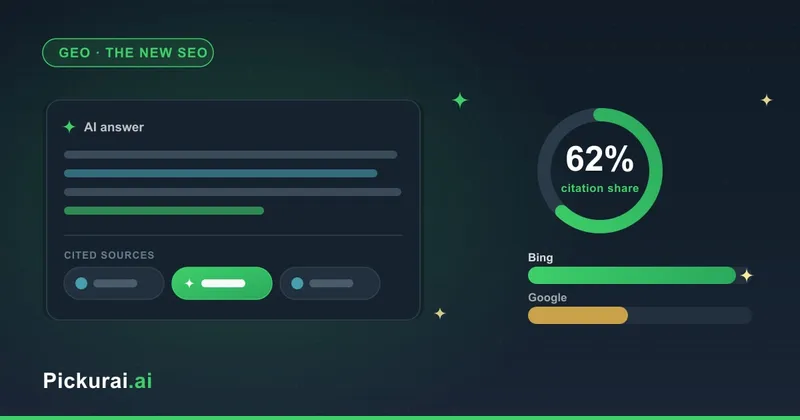
Search engine optimization is quietly splitting in two. There is still the old game — rank a blue link on Google — and there is a new one: get your page cited inside the AI answer that increasingly sits above those blue links. That second game has a name now, generative engine optimization (GEO), and this morning Bing handed us the best measurement tools anyone has shipped for it yet: Intents, Topics, Citation Share and Compare. The blunt takeaway from where I sit, running an AI site that lives and dies by search: Bing has lapped Google Search Console on AI visibility, and it isn't close.
I'll say up front what I mean by "we." I run Pickurai, a small site that recommends AI tools. We obsess over SEO because it's how people find us — and over the last few months, a growing share of the humans who land here didn't come from a blue link at all. They came because an AI assistant cited us in an answer. When that channel started mattering, it needed metrics. Bing just gave them to us before Google did.
This piece, in six lines
- GEO is the new SEO. Generative engine optimization is the practice of getting your content surfaced and cited inside AI-generated answers, not just ranked in a list of links.
- AI referrals are already real traffic. For an AI-focused site, a meaningful slice of visits now arrives via citations in Copilot, ChatGPT, Gemini and Bing's own answers — so it has to be measured.
- Bing shipped the metrics first. On June 2026 it added Intents, Topics, Citation Share and Compare to its AI Performance report, all in preview.
- Google is months behind. Google's gen-AI report launched June 3, 2026 tracking impressions only — no queries, no clicks, no click-through rate — and rolled out to a subset of UK sites first.
- The optimization playbook changed. Self-contained, quotable sentences, specific facts, clear intent match and structured data now matter as much as backlinks.
- We're rebuilding Pickurai around it — and you can copy the moves whether your site is big or tiny.
What GEO Actually Is
Generative engine optimization is the practice of shaping your content so that AI systems — Bing Copilot, ChatGPT, Gemini, Perplexity and the AI answers now baked into search — pull from it, quote it, and cite it. Classic SEO optimizes for a ranking: a position in a list of ten links. GEO optimizes for a citation: being one of the handful of sources an AI reads, trusts, and names when it composes an answer. The two overlap, but they are not the same, and the difference is starting to show up in traffic.
The mechanic underneath is what the industry calls grounding. When an AI answers a real question, it doesn't just free-associate from training data; it runs searches, retrieves live pages, and grounds its answer in that evidence — then lists those pages as sources. GEO is the discipline of being one of the pages it grounds on. If SEO was about being findable, GEO is about being quotable.
SEO got you ranked. GEO gets you quoted. The winning page is no longer the one with the most backlinks — it's the one an AI can lift a single clean sentence from and cite with confidence.
Why We Started Caring — AI Visits Are Real Now
For most of the web this is still a rounding error. For a site like ours, it isn't. Our readers are, by definition, people comfortable asking an AI "what's the best tool for X?" — and when they do, the assistant increasingly answers with a shortlist and a few cited sources. If Pickurai is one of those sources, we get the visit and the trust that comes with being named by the AI. If we're not, we're invisible in the exact moment our ideal reader is deciding.
That's a strange, uncomfortable place to be as a publisher, because it collapses the old funnel. There's no page-two to climb from; either the model cites you in the answer it's writing right now, or it doesn't. It also rewards a specific kind of writing — clear, specific, self-contained — over the keyword-padded filler that used to rank. We already lean that way (it's the same reason we argue the most popular AI isn't always the best one for you), but GEO turns that preference into a measurable growth channel. The only thing missing was a dashboard. Now there's one.
What Bing Just Shipped: Intents, Topics, Citation Share, Compare
Bing has been building this out for a while — the AI Performance report entered public preview back in February 2026 — but the update that landed today is the one that makes it genuinely useful. Four new capabilities, all in early preview, sit on top of the grounding-query data that shows which of your pages AI answers cite. Here's what each one does and why it matters for GEO.
1. Intents — the "why" behind every citation
Grounding queries are now classified into categories like Informational, Commercial, Research, Learn & Solve, and Local (Bing lists more, including Navigational and Creation). This is the feature I care about most. Knowing an AI cited you is useful; knowing it cited you for a commercial-investigation query versus a purely informational one tells you whether that citation is near money or near the top of the funnel. It lets you shape content to match the intent the model is actually answering — the exact discipline classic SEO taught, now applied to AI answers.
2. Topics — visibility grouped the way models think
Related queries are rolled up into broader thematic clusters — Bing's example is "solar panels" + "solar energy efficiency" collapsing into a single Solar Energy topic. Instead of drowning in a thousand individual query strings, you see visibility at the level of subject areas, which is much closer to how modern AI systems actually organize and retrieve information. For us that means seeing, at a glance, whether we own "AI writing tools" or "AI video tools" as a topic — not just scattered long-tail phrases.
3. Citation Share — your slice of the answer
This is the headline metric. Citation Share tells you how much of the citation space your site holds for a given grounding query — your share across every source the AI cited, expressed as a percentage. Raw citation counts told you that you showed up; Citation Share tells you how dominant you are relative to everyone else answering the same question. It's the AI-era equivalent of share-of-voice, and tracked over time it's a directional read on whether your visibility is growing or getting eaten.
4. Compare — did that content change actually help?
Compare lets you overlay a previous period on your current view — last 30 days against the prior 30, or custom ranges. That closes the loop. You rewrite a page for GEO, then watch whether your citation activity for its topic actually moved, separating your edits from seasonality or ecosystem shifts. Without a before-and-after, GEO is guesswork; Compare turns it into something you can iterate on.
Bing is candid that these are early preview and "improving fast — you may spot the occasional inaccuracy." Fair. But directionally, this is the first time I've been able to answer "which questions is an AI citing us for, how commercial are they, how big is our slice, and is it growing?" — from one dashboard.
Bing Lapped Google Search Console — and It's Not Close
Here's the part that genuinely surprised me. For twenty years the reflex was: SEO lives in Google Search Console, and Bing Webmaster Tools is the thing you configure once and forget. On AI visibility, that has flipped hard.
Google did ship its own answer. On June 3, 2026 it introduced generative-AI performance reports in Search Console, covering impressions in AI Overviews and AI Mode. That's real, and welcome. But the v1 report tracks impressions and nothing else — no clicks, no position, no click-through rate, and crucially no query data. You learn that your URLs appeared in AI features; you don't learn which questions triggered them, how commercial those questions were, what your share of the answer was, or how any of it is trending against a prior period. It also began rolling out to a subset of website owners in a single country (the UK), with global access "coming" but undated.
Line them up and the gap is stark. Bing gives you query-level grounding data, classifies it by intent, clusters it into topics, quantifies your citation share, and lets you compare periods — globally, today. Google gives you a count of impressions, no queries, in one country's beta. That's not a small feature-parity gap; it's Bing being several months and several layers of depth ahead on the metrics that actually describe AI visibility.
On AI visibility in mid-2026, Bing Webmaster Tools is the advanced product and Google Search Console is the one playing catch-up. I did not have that on my bingo card.
The likely reason isn't a mystery: Bing's grounding data feeds Microsoft Copilot and a set of partner AI experiences, so Microsoft has both the pipeline and the strategic reason to expose it. Google, meanwhile, has to build AI reporting without cannibalizing the click-based Search it still monetizes — which may be exactly why its first report conspicuously omits clicks. Whatever the cause, the practical advice for now is simple: if you want to see how AI is citing you, start in Bing.
How We're Adapting Pickurai for GEO
Metrics only matter if they change what you make. Here's what these tools are actually pushing us to do — and none of it requires being a big site.
- Write extractable sentences. Models lift single sentences, so we put the claim and its qualifier in the same sentence and avoid pronouns that need the previous line for context. Every key fact should survive being copy-pasted out of the page on its own.
- Lead with the answer. We front-load the direct answer in the first two or three sentences, then expand. An AI grounding on the page finds what it needs immediately, and so does a human.
- Be specific — numbers, names, dates. "Bing added four AI metrics on June 2026" is citable; "Bing improved its tools recently" is not. Specificity is what makes a passage worth quoting.
- Match intent deliberately. Now that Intents shows us whether a citation is informational or commercial, we write the page for the intent behind the query instead of guessing — a buying-guide for a commercial question, a plain explainer for an informational one.
- Build topics, not orphan pages. Because Topics clusters queries into subjects, we're linking related articles into tight topic hubs so we own a subject area rather than a single stray phrase.
- Keep the structured data honest. Article schema, clean headings, and a short key-takeaways block near the top give models clean, labeled facts to ground on — the same blocks you're reading in this piece.
None of that is a trick. It's just good writing with a new payoff: the clearer and more specific we are, the more often an AI can quote us — and the citation-share numbers now tell us whether it's working. It's also why we keep publishing things like our monthly AI tool index: specific, dated, structured data is exactly what AI answers reach for.
What This Means for You
If you run a site — any site — the short version is: don't wait for Google. Open Bing Webmaster Tools, find the AI Performance report, and look at which questions AI is already citing you for, what intent they carry, and how big your slice is. Then write the way models reward: answer first, one idea per paragraph, specific facts stated in self-contained sentences, honest structured data. GEO isn't a separate content strategy from good SEO — it's the same instinct, pointed at a new surface, and now finally measurable. And if what you're actually trying to figure out is which AI tool to use for any of this, that's literally what we built the free wizard for.
The Bottom Line
SEO didn't die; it grew a second head. The old game of ranking links is still here, but a new one — getting cited inside AI answers — now sends real traffic, and for AI-native sites like ours it's already a channel we can't ignore. As of today, Bing is the place to measure that game: Intents, Topics, Citation Share and Compare give publishers a genuine view into AI visibility while Google Search Console is still shipping an impressions-only beta in one country. I don't know how long Bing keeps this lead, and knowing Google, probably not forever. But right now, if you care about being visible where people increasingly ask their questions, GEO is the new SEO — and the scoreboard is in Bing.