

Other people let an agent use their inbox before I did. For months my feed kept serving the videos. I watched them. Then I stopped watching and tried it myself.
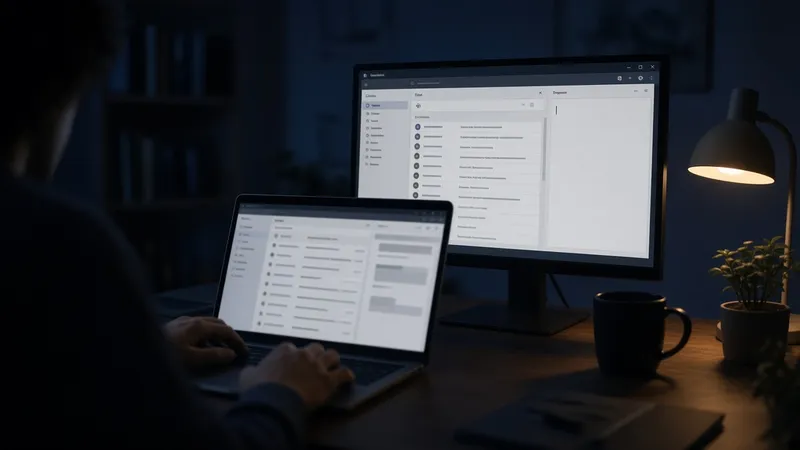
I gave Grok, inside a Cursor project, access to my email. The agent runs on a remote computer, and that computer has the mail account. I can open the session and watch Grok read, write, and send. When I want to see the work, the mail client is on the screen and the agent is in it.
Two days later I had written to public administrations across Europe and Africa. One email each. Each one written for that office, asking for the specific thing I needed. About fifty messages. The AI usage came to about €20.
The run, in one look
- Tool: Grok, inside a Cursor project, on a remote computer that has my email.
- What I could see: the agent in the mail client, whenever I opened the session.
- What went out: about 50 personalized emails to public offices in Europe and Africa, in two days.
- What it cost: about €20 in AI usage, October 2026. Roughly €0.40 a message.
- What the same list costs me by hand: at least two weeks.
- What it still needs: supervision, and a learning curve that the videos skip.
What the setup actually is
Cursor is already where I work. I wrote about leaving Claude for it, and about running agents from my phone. This is a different job for the same kind of agent. A project. Grok as the model. A remote machine that can open my mail.
The permissions are the part that takes time. An agent that can send from your address can send the wrong thing from your address. Mine took a real learning curve. The videos compress the first working day into an afternoon. Mine took longer than that. I had months of other people's demos in my head before the first send I trusted.
Once that trust was there, the loop was easy to follow. Grok sits in the mail. I look in when I want. The list keeps moving when I look away. Any mail task I used to postpone now has a worker who can start it: reply, chase, draft, file.
Two days, and a list I used to dread
The job was a list. Find the office. Find the inbox that actually receives this kind of request. Write something that is about their office and about what I needed. Send it. Take the next one.
By hand, that list is at least two weeks. A single email is easy. Dozens of them, each one specific, is a different kind of work. These were public administrations in Europe and Africa. One note each, asking for the particular thing I needed from that office.
Grok ran the list. I checked in and watched it use the mail client. The odd part was the feeling of having someone on staff. A worker in the account, moving through the offices, while I did other things and dropped in to see the screen.
For real one-to-one mail, this is the cheapest commercial tool I have used. It writes the next message for that recipient, then the one after. The price of a mailing product usually buys one template sent to a list. Here the spend bought the loop: research the office, write the ask, send it, log it, continue.
About €20 for fifty emails
About fifty emails. About €20 of AI usage, counted in October 2026. That is roughly €0.40 a message.
The comparison I have is time. The same list, typed by me, was two weeks at the low end. €20 against two weeks is the number that changed how I think about the inbox.
It stays that cheap when the task repeats and you still supervise the messages that carry your name into a public office. I read those. A routine follow-up gets less of my attention. Telling those two apart is part of the work, and it is what keeps the €20 from turning into a correction email.
The curve, and why I still watch
The €20 leaves out the real entry cost. Months of watching other people. Then a setup that was genuinely hard. Then a result that made the setup worth it. The middle is where this either becomes useful or becomes a mistake with your name on it.
Supervision stays. I can see the remote computer and the mail client on it. That view is why I was willing to let Grok write to administrations. The agent is strong at the tedious half: find the address, write the specific ask, send it, take the next office. I still own the account. I still decide what finished means. I still read anything that could embarrass me.
What I think this is
I have felt, on my own time, a bit more of how desk work is going to go. People who already spend the day on a computer are going to change how that day is spent. The change is concrete. A task that used to be two weeks can be two days, for about the price of a dinner, with a worker you can watch on a remote screen.
The inbox was the obvious place to start. It is the tip. Plenty of other work has the same shape: a long list, a specific action each time, and a person who should see it without typing all of it. Sorting the mail you already receive is a different job: how to automate your email inbox.
If you are choosing a model for work like this, use the six-question form. I used Grok because that is the model I pointed at the project. The €20 is the usage on this run, in October 2026.